
As April advances in the Andean highlands, ecological processes become increasingly dynamic. The initial stages of emergence and rooting give way to more complex interactions among water, soil, vegetation, and human activity. Growth no longer depends solely on establishment; it depends on the capacity of systems to sustain flow.

In this context, flow refers not only to the physical movement of water, but to the circulation of life across interconnected systems. Seasonal rains, soil absorption, plant uptake, and human intervention form part of a broader network of exchanges that sustain agricultural and ecological continuity.
Flow Within the Hydrosocial Cycle
Andean agricultural systems cannot be understood through purely naturalistic frameworks. Water, as a central element of life, moves through what has been described as a hydrosocial cycle, in which ecological processes and social practices remain inseparable.

Within this cycle, flow emerges through the interaction between environmental conditions and human management. Irrigation practices, land use decisions, and communal organization all shape how water circulates across the landscape.
Flow, in this sense, is not an autonomous process. It is co-produced through relationships between human and non-human actors.
Maintaining Flow as Agricultural Practice
Farmers across the Andes actively engage in maintaining the conditions that allow it to continue. This involves guiding water through irrigation channels, managing soil permeability, and adapting to seasonal variations in rainfall.
These practices do not impose external control over the land.
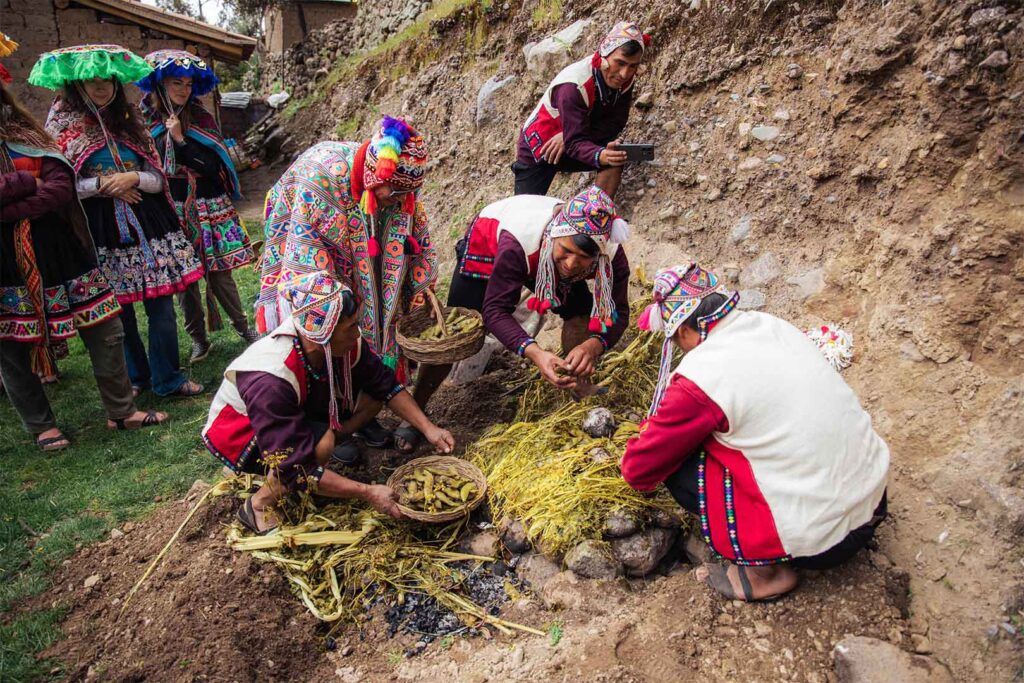
Instead, they respond to existing dynamics, ensuring that the movement of water and nutrients remains continuous.
Interruptions in flow, whether due to environmental shifts or mismanagement, can disrupt agricultural productivity. For this reason, maintaining flow becomes a central concern within Andean farming systems.
Flow as a Relational Ontology
Beyond its material dimension, flow also reflects a broader ontological perspective. Andean cosmology understands life as inherently relational and dynamic. Processes do not occur in isolation; they unfold through continuous interaction.
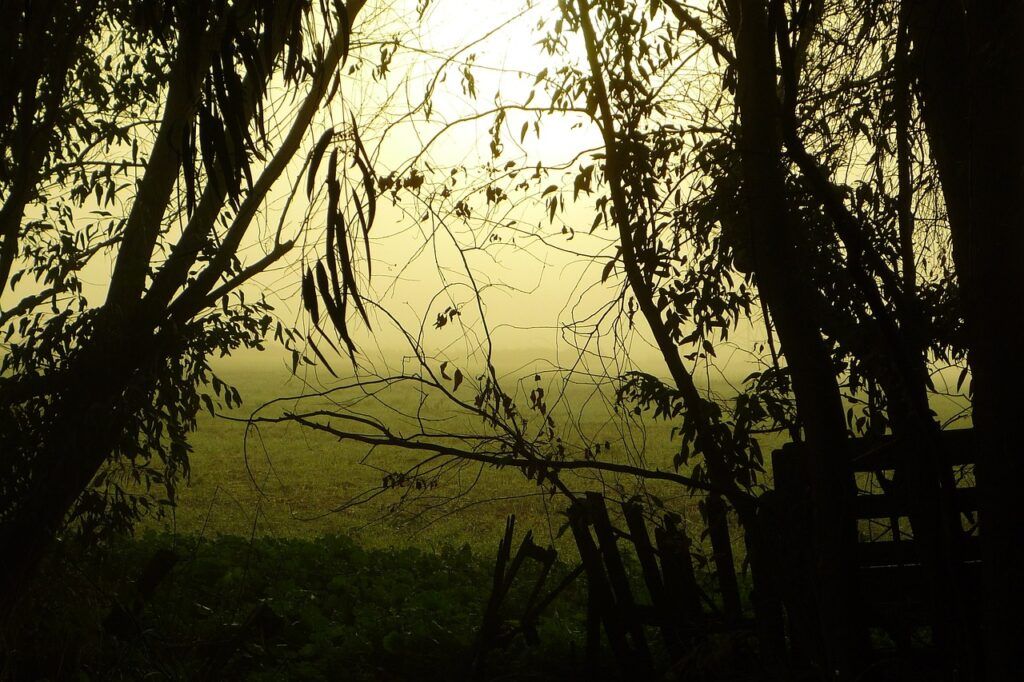
Within this framework, it represents the ongoing movement that connects different elements of the world. It links cycles of growth, patterns of climate, and forms of human participation.
This perspective challenges static interpretations of nature, emphasizing instead the importance of movement and exchange.
Implications for Human Experience
The concept of flow extends beyond agricultural contexts. Human processes, cognitive, emotional, and social, also depend on the ability to maintain continuity in movement.
When flow is sustained, development occurs with greater coherence. When it is obstructed, stagnation may arise.

April, therefore, offers a model for understanding how systems, both ecological and human, require movement in order to function effectively. Supporting flow becomes a way of sustaining life across multiple levels of experience.
References
- Boelens, R. (2014). Cultural politics and the hydrosocial cycle: Water, power and identity in the Andean highlands. Geoforum, 57, 234–247.
- Zimmerer, K. S. (1996). Changing fortunes: Biodiversity and peasant livelihood in the Peruvian Andes. University of California Press.
- Gelles, P. H. (2000). Water and power in highland Peru: The cultural politics of irrigation and development. Rutgers University Press.
This article draws on both academic literature and oral, lineage-based Andean knowledge. Teachings that originate from living traditions are cited in recognition of their ongoing transmission within Andean communities, while scholarly sources are used to support contextual interpretation.