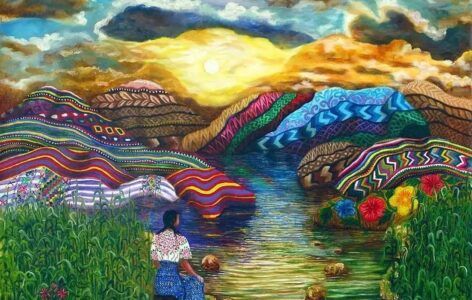
What appears as chaos, flooding, emotional overwhelm, structural disruption, functions as medicine within Andean thought, signaling reordering rather than collapse (Allen, 2002).
Rethinking Chaos in Andean Thought
In many Western frameworks, chaos is treated as something to be eliminated, an interruption to productivity, clarity, or order.

In Andean worldviews, however, disorder is not inherently negative. Andean worldviews treat certain moments of chaos as thresholds, where transformation quietly takes shape.
Rather than opposing order, Andean traditions frame chaos as a phase within a living cycle, one that emerges especially during periods of seasonal, emotional, or spiritual transition.
Disorder as a Sign of Life in Motion
Andean cosmology does not imagine the world as static or fixed.
Life unfolds through constant negotiation between stability and disruption.
Moments of imbalance signal that something is reorganizing, not that something has failed.

Ethnohistorical studies show that agricultural, ritual, and social calendars accounted for periods of uncertainty, times when outcomes were not yet visible and control was intentionally loosened (Flores Galindo, 2010).
Chaos, in this sense, becomes a diagnostic moment, revealing where rigidity has replaced relationship.
Sacred Disruption and Pachakuti
Andean traditions understand pachakuti as one of the most powerful concepts related to chaos, often translated as “world reversal” or “cosmic turning.”
Pachakuti does not represent destruction for its own sake, but a radical reordering of time, space, and meaning.

Historically, pachakuti moments appear in oral histories during periods of social upheaval, ecological crisis, or spiritual renewal. These moments are remembered not only for loss, but for the new relational orders they made possible (Gisbert, 1999).
Sacred disorder opens space for a different configuration of life to emerge.
Chaos, Emotion, and the Body
Disorder is not experienced only at the collective level. Andean traditions read emotional turbulence, confusion, grief, restlessness, as knowledge carried by the body.
Rather than suppressing these states, ritual and communal practices help contain them, allowing chaos to move through the body without becoming destructive.
Emotional disarray signals that internal structures are being unsettled, opening a space for reconfiguration rather than immediate coherence (Rivera Cusicanqui, 2015).
Chaos becomes medicine when it is witnessed, not pathologized.

Hucha and the Mismanagement of Disorder
Chaos becomes harmful only when it is denied or forcibly controlled. When communities suppress disorder, emotionally, socially, or ecologically, hucha forms as dense energy that disrupts relational harmony.

From this perspective, modern urgency to “fix,” “optimize,” or “stabilize” everything too quickly is seen as spiritually risky. It interrupts the necessary phase of not-knowing that allows deeper alignment to form.
Medicine requires timing.
January and Sacred Uncertainty
Within the Andean seasonal cycle, January often embodies this sacred uncertainty. Heavy rains, unstable paths, and heightened emotional states reflect a world in active reconfiguration.

This is not a time for rigid plans or premature conclusions. It is a time for listening, observing, and allowing disorder to teach. Life is reorganizing beneath the surface, and clarity has not yet earned the right to appear.
To rush resolution during this period is to interrupt medicine mid-process.
Learning to Trust the Unfinished
Chaos as medicine invites a different ethical posture:
- Trust without immediate explanation
- Presence without control
- Patience without passivity
In Andean spirituality, healing does not always feel calm. Sometimes we feel disoriented because old structures dissolve before new ones take form.
Sacred disorder is not the absence of meaning, it is meaning in formation.
References
- Flores Galindo, A. (2010). Buscando un Inca: Identidad y utopía en los Andes. Instituto de Apoyo Agrario.
- Gisbert, T. (1999). El paraíso de los pájaros parlantes: La imagen del otro en la cultura andina. Plural Editores.
- Rivera Cusicanqui, S. (2015). Sociología de la imagen: Miradas ch’ixi desde la historia andina. Tinta Limón Ediciones.