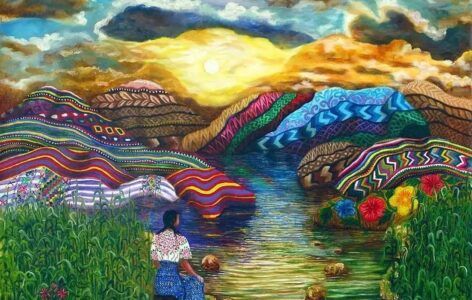
For the Inca, the Sun, Inti, was far more than a celestial body. He was the beating heart of the cosmos, the giver of life, and the ancestor of kings. Every dawn marked not only the renewal of light but the reaffirmation of sacred order. It remind humanity of its place within the vast circle of reciprocity that binds all beings to Pachamama and the Apus.

In the Andean worldview, Inti does not simply shine he breathes, he listens, and he feeds the world with Kawsay.
Inti and the Origins of Life

According to Inca mythology, Inti was both father and sustainer. He sent his children, Manco Cápac and Mama Ocllo, to emerge from the sacred waters of Lake Titicaca and found Cusco. From there, the first Inca lineage began, claiming descent from the solar bloodline, a direct link between divine radiance and human stewardship.
The Sapa Inca, the emperor, was known as Intip Churin, the Son of the Sun, whose duty was not to dominate but to maintain harmony between heaven and earth. His reign symbolized the balance between the three worlds, reflecting the golden path of the sun across the sky.
The Temple of the Sun: Qorikancha
At the center of Cusco, the Qorikancha stood as the most sacred temple of the Inca Empire. Its walls, once covered with sheets of pure gold, glimmered like dawn itself, reflecting Inti’s light in all directions.
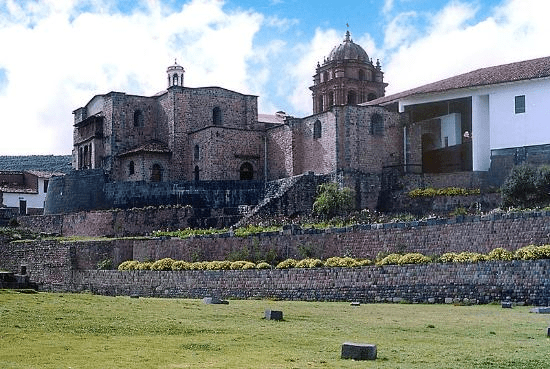
Here, priests conducted daily offerings of chicha, flowers, llama fat, and coca leaves, ensuring the reciprocal flow of energy between humanity and the solar deity. During solstices, the rays of the sun aligned perfectly with the temple’s niches, turning the structure into a living calendar, a dialogue between architecture and astronomy.
As anthropologist Brian Bauer (1998) explains, the Qorikancha served as the cosmic center, linking political authority, agricultural cycles, and divine order (The Sacred Landscape of the Inca).
Inti Raymi: The Renewal of the Sun
Each June solstice, when the sun reached its lowest point in the southern sky, the Inca celebrated Inti Raymi, the Festival of the Sun. This ceremony marked the rebirth of Inti, ensuring the continuation of light, fertility, and life.

The people gathered in Saqsayhuaman, dressed in vibrant textiles symbolizing the rays of the sun, offering songs, dances, and sacred foods. For them, to celebrate Inti was to participate in the cosmic rhythm, to give thanks for warmth, crops, and time itself.
As Inca Garcilaso de la Vega recorded in his Comentarios Reales (1609), the Inca believed that “without Inti’s blessing, neither man nor maize could live.” Thus, gratitude was a form of survival, and ritual a way of maintaining harmony with the universe.

References
- Allen, C. J. (1988). The Hold Life Has: Coca and Cultural Identity in an Andean Community. Smithsonian Institution Press.
- Bauer, B. S. (1998). The Sacred Landscape of the Inca: The Cusco Ceque System. University of Texas Press.
- Garcilaso de la Vega, I. (1609). Comentarios Reales de los Incas. Lisbon: Pedro Crasbeeck.