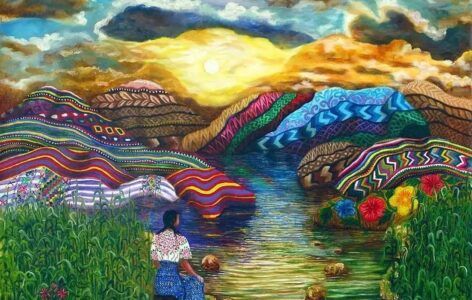
As March begins, subtle signs of emergence unfold across the Andean landscape.
The rains continue to nourish the soil, yet the rhythm of the season shifts.
What remained hidden during the previous months begins to show its first visible signs.
Shoots appear in the fields, colors deepen across the hillsides, and the land slowly reveals what it has been preparing.

This emergence does not arrive abruptly. Life rises gradually, moving from the darkness of the soil toward the open air. The process reflects a cosmological rhythm in which visibility follows long periods of preparation. Growth does not begin at the moment we see it; it begins long before, within conditions that allow life to organize itself quietly.
March therefore marks a moment when the unseen becomes perceptible.
Emergence as Continuity, Not Beginning
In Andean cosmology, emergence does not represent a sudden beginning. Instead, it signals the continuation of processes that have already taken place beneath the surface. The rains of earlier months softened the soil, seeds absorbed water, and roots began to form long before any leaf appeared.

When life breaks the surface, it carries the memory of everything that supported its formation.
This understanding challenges the idea that visibility defines reality. What appears above ground reflects deeper layers of activity that remain essential to the process of growth. Emergence reveals the results of relationships, between water, soil, sunlight, time, and human care.
The Fragility of First Movement
The first signs of growth require careful attention. Young plants remain delicate, and sudden exposure can threaten their development. Farmers throughout the Andes recognize that early emergence demands protection rather than acceleration.

The same principle applies to human experience. New ideas, emotional shifts, and spiritual insights often surface gradually. When something begins to take form after a long period of gestation, it benefits from patience and observation.
March teaches that the first appearance of life invites responsibility.
Walking With The Emergence
Emergence also changes the role of those who witness it. Once life becomes visible, relationships deepen. Farmers walk through their fields to observe the condition of the crops. They look closely at the leaves, the soil, and the presence of water. Attention becomes a form of participation in the growth process.

Human beings participate in the same way when they recognize what has begun to move within their own lives. The task is not to control the process, but to accompany it with awareness.
Walking with what has appeared means staying attentive to the conditions that sustain growth.
A Season of Careful Attention
March invites a different kind of presence. February asked for listening and patience while life remained hidden. March asks for observation and care as life becomes visible.
The emergence of growth does not end uncertainty. Instead, it opens a new phase of relationship with what is developing.

The land continues to teach that every visible form depends on conditions that must be protected and maintained.
When life breaks the surface, it reminds us that growth is never an isolated act. It is always the expression of many relationships working together over time.
References
- Allen, C. J. (2002). The hold life has: Coca and cultural identity in an Andean community. Smithsonian Institution Press.
- Urton, G. (1981). At the crossroads of the earth and the sky: An Andean cosmology. University of Texas Press.
- Rengifo Vásquez, G. (2001). La crianza de la chacra en los Andes. PRATEC – Proyecto Andino de Tecnologías Campesinas.
This article draws on both academic literature and oral, lineage-based Andean knowledge. Teachings that originate from living traditions are cited in recognition of their ongoing transmission within Andean communities, while scholarly sources are used to support contextual interpretation.