
By mid-August, as the earth heats up and the irrigation channels rush with glacial melt, the physical world sparkles with raw, active energy. To anchor these rapid environmental changes, master weavers set up their backstrap looms in open courtyards under the brilliant sky. Their focus turns to crafting the Lliklla, a traditional woven shoulder mantle worn over the upper back and heart center.
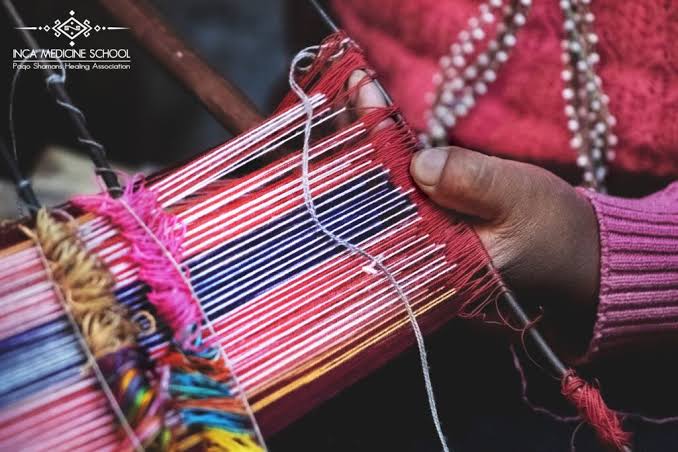
Weaving a Lliklla is not merely an artistic endeavor. It is a rigorous practice of somatic geometry, embedding dynamic forces into a physical shield.
The Architecture of Lliklla
The Lliklla is constructed from two symmetrical panels joined down the middle by a hand-stitched central seam (Ch’ila). This central join aligns directly with the human spine, acting as an energetic axis.
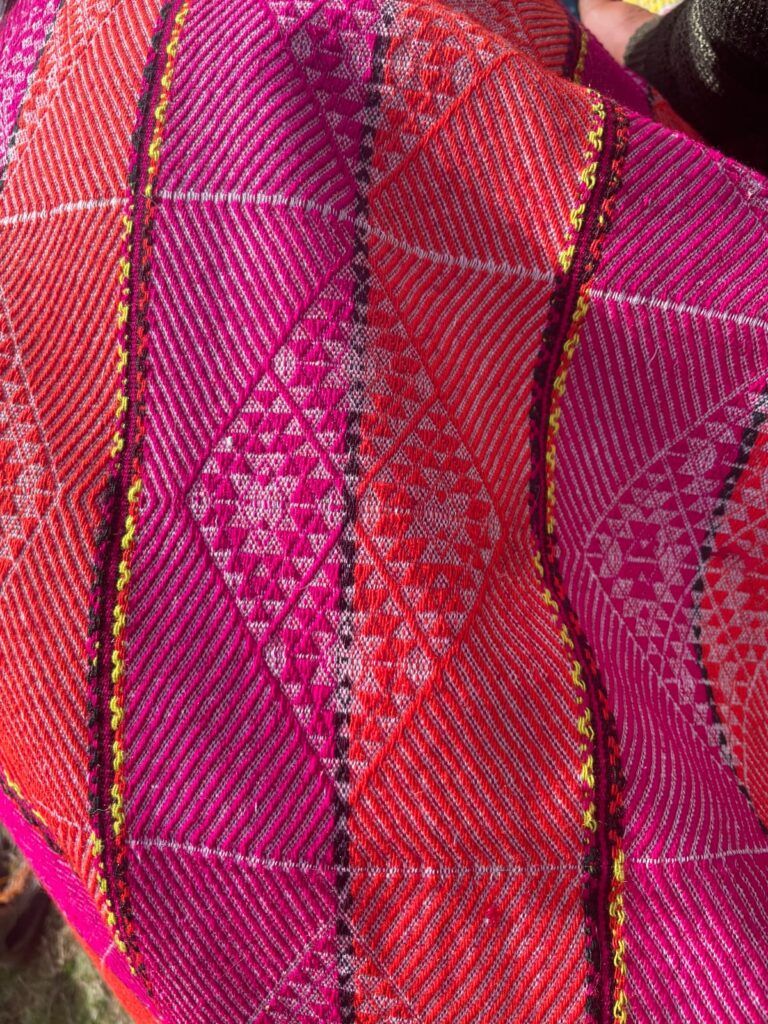
This structural symmetry reflects the core therapeutic principle of Tinkuy, the harmonious meeting of opposing forces. Inner disharmony occurs when our dual energies, masculine and feminine, action and rest, light and shadow, fall out of balance.
By tensioning the loom threads with her own body weight, the weaver balances every single thread.
As she beats down the horizontal warp with her bone tool (K’ichay), she locks these opposing forces into perfect equilibrium.
Wearing a finished Lliklla wraps your upper heart and lungs, the primary centers of emotion and breath. It wraps into a structured geometric grid that stabilizes your subtle energy field against external environmental friction.
The Code of the Pallay
The central decorative bands (Pallay) woven into the mantle carry precise cosmological iconography:
- Inti Lorayku (Sun Rays): Diamond geometries that absorb solar heat and radiate vitality directly into the wearer’s heart center.
- Qocha Patan (Water Borders): Zig-zag lines that mirror the rushing irrigation canals of mid-August, keeping the wearer’s emotional current fluid and unblocked.
- K’uychi (Rainbow Arches): Multi-colored bands that bridge the upper world with the physical world, granting spiritual immunity.
Wearing this textile during mid-August connects your individual field to the greater cosmic loom of the Andes, transforming your garment into a living shield that holds your personal power secure.
“A thread pulled too tight will snap; a thread left too loose will tangle. Balance the loom with your body, and your body will learn the balance of the loom.”
The Vocabulary of Lliklla
- Lliklla: A hand-woven rectangular shoulder mantle worn by women to protect the heart center, carry children or goods, and signal spiritual lineage.
- Tinkuy: The sacred confluence, meeting, or harmonious integration of two complementary opposites.
- Pallay: The intricate, memory-encoded geometric patterns woven into Andean textiles that represent sacred geography, celestial maps, and spiritual laws.
The Centers of Sacred Geometry
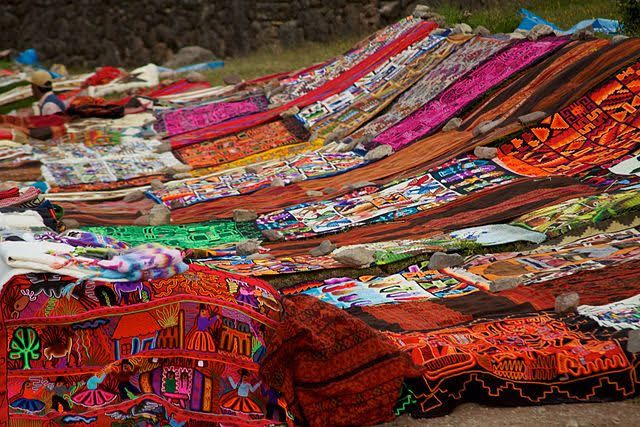
- The High Weaving Village of Chinchero: Perched on a high windswept plateau, Chinchero weavers still spin, dye with natural plants, and construct Llikllas using centuries-old backstrap techniques that mirror the surrounding mountain horizons.
- The Textile Sanctuary of Pitumarca: Located near the base of Apu Ausangate, weavers in this remote valley maintain rare, complex Incan weaving structures (Ticlla) that bind multiple layers of energy directly into ceremonial mantles.
References
- Cereceda, V. (1986). The Semiology of Andean Textiles: The Lliklla of Isluga.
- Silverman, G. (1998). Seeing with a Native Eye: Essays on Native American Religion. Harper & Row.
This article draws on both academic literature and oral, lineage-based Andean knowledge. Teachings that originate from living traditions are cited in recognition of their ongoing transmission within Andean communities, while scholarly sources are used to support contextual interpretation.