Across high mountain villages, entire communities gather under the principle of Ayni Mink’a, the communal mobilization of labor rooted in reciprocal spiritual duty.
In shamanic energy healing, human health is never isolated within an individual body. True vitality requires an unblocked, harmonious flow of energy between the person, their social web (Ayllu), and the living landscape.
The Mechanics of Ayni Mink’a
When an individual steps into their neighbor’s field to turn soil with a traditional foot plow (Chakitaklla), they do not view the effort as a chore or a transactional debt. Instead, they engage in Yanapay, the practice of heartfelt service.
This communal effort highlights a core principle of energy healing: isolated effort drains personal vitality, while shared purpose amplifies it.
Working side-by-side on steep stone terraces, rhythmically striking the soil together to the rhythm of ancestral songs, clears individual fatigue and heavy energy.
The physical burden distributes across many shoulders. It replaces social isolation and emotional exhaustion with a buoyant field of collective vitality (Kawsay). You give your physical energy freely today, knowing with absolute certainty that when your own field needs planting, the collective strength of the community will stand beside you.
The Sacred Pact of Food and Spirit
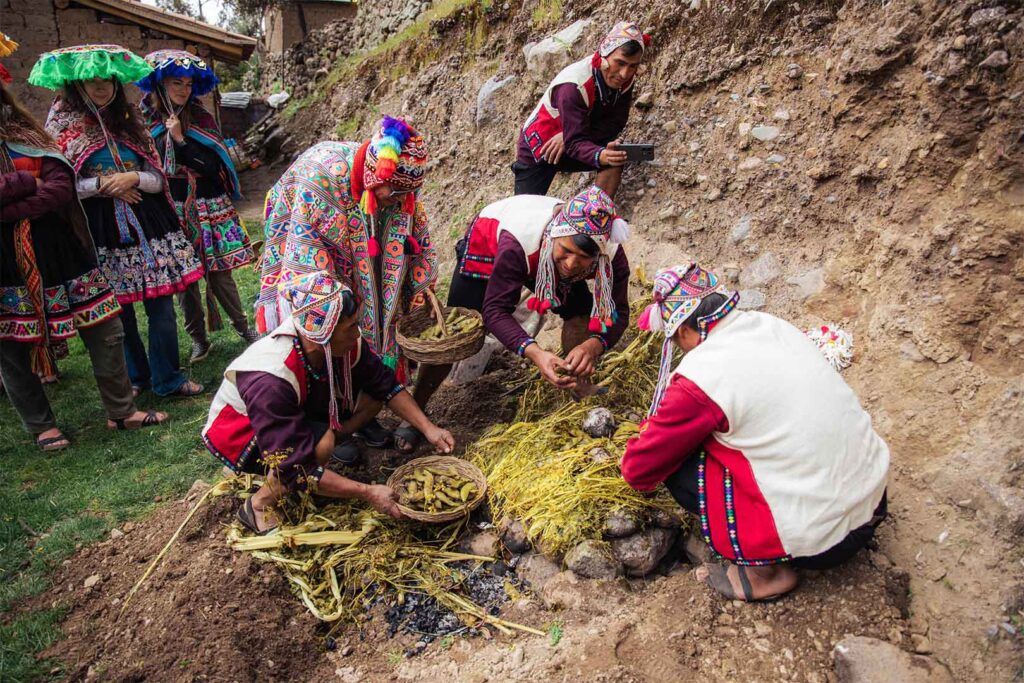
The workday concludes with a shared feast (Mestura) sitting directly upon the earth floor. Steaming bowls of native potatoes, quinoa, and maize are distributed equally among workers, elders, and children.
Before taking a single bite, each worker spills a drop of broth and leaves a portion of food upon the earth as a Ch’alla offering.
This gesture seals the energetic contract:
Human hands worked the soil together, human hearts shared equal nourishment, and the earth received her due respect.

A single string breaks under the slightest pull; woven together into a rope, those same threads can pull a mountain. Build your human web before the harvest arrives.
The Vocabulary of Ayni Mink’a
- Ayni: The foundational cosmic law of sacred reciprocity, mutual aid, and direct energetic balance (“Today for you, tomorrow for me”).
- Mink’a: A traditional system of voluntary communal labor performed for the benefit of the entire village or a specific family in need.
- Ayllu: The sacred social structure of the Andes, encompassing extended family, neighbors, ancestral spirits, and the local mountain guardians.
The Valley of Communal Abundance
- The Terraced Fields of Pisac: Surrounding the lower agricultural terraces of the Sacred Valley, farming families gather every late August to pool their livestock, plows, and labor to sow native corn varieties in collective alignment.
- The High Potato Park (Parque de la Papa – Chawaytire): Located in the mountains above Pisac. Five indigenous communities manage over a thousand native potato varieties using strict Ayni labor rotation systems that preserve genetic and spiritual diversity.
References
- Mayer, E. (2002). The Articulated Peasant: Household Economies in the Andes.
- Isbell, B. J. (1978). To Defend Ourselves: Ecology and Ritual in an Andean Village.
This article draws on both academic literature and oral, lineage-based Andean knowledge. Teachings that originate from living traditions are cited in recognition of their ongoing transmission within Andean communities, while scholarly sources are used to support contextual interpretation.