logo im

Conversations with Maestro Raul – Part 2

Posted on

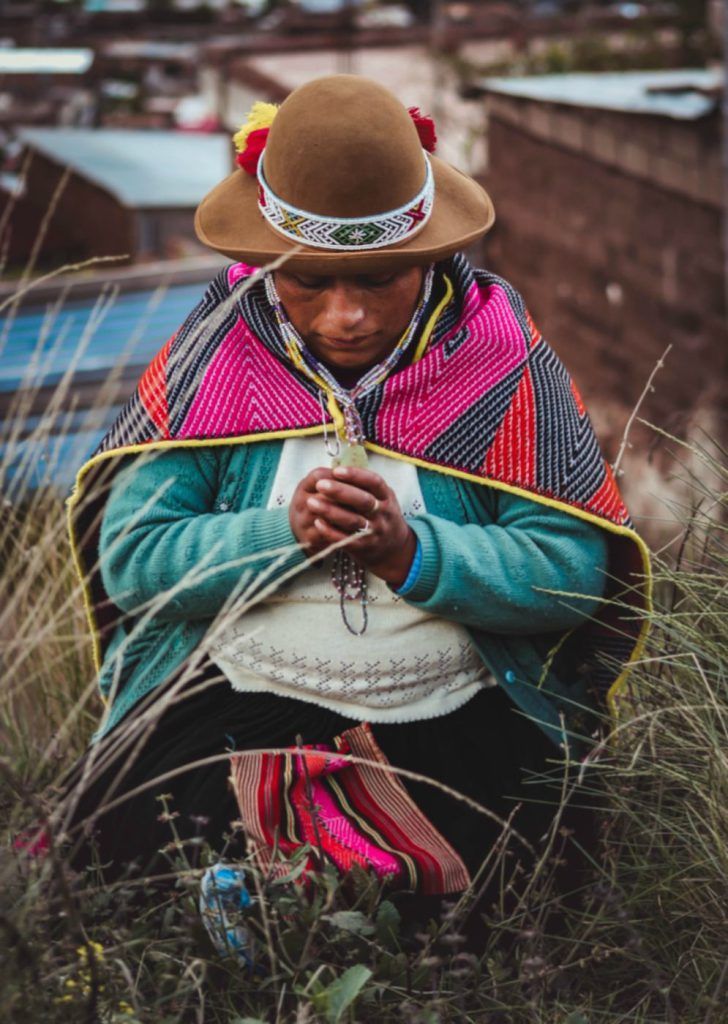
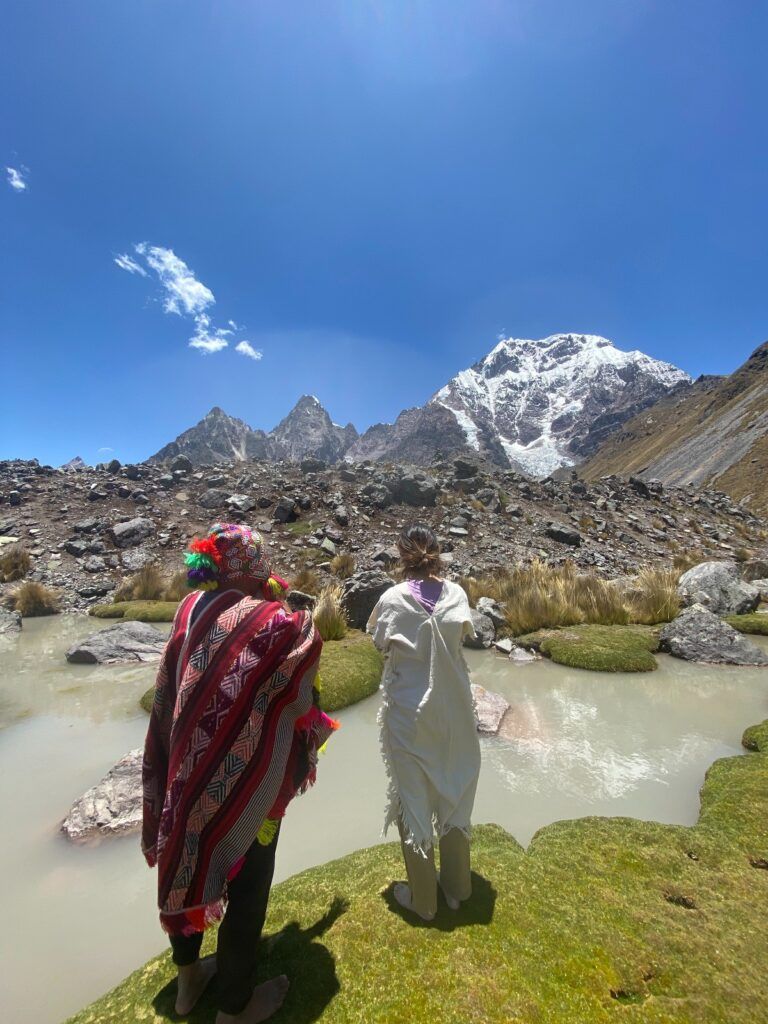
Master Raul in a cleansing ceremony

The other day we went to do a cleansing ceremony (Pichay) and a call for encouragement (Waqhay). Maestro Raul drove with caution in the busy Cusco morning traffic.

After our conventional conversations, I became very interested in his thoughts on the Catholic religion.

I mentioned how the white and red wine used in his ceremonies reminded me of church masses, which sparked our discussion on the topic.

Master Raul in a cleansing ceremony.

He told me that as a child in the community of Kiko, he knew a Danish father who respected local traditions. This father wore an unku (bag), celebrated masses in Quechua, donned the community’s poncho, and chewed coca.

Paqos believe in Jesus and God

This is how the maestro Raul decided to become a catechist and says “I also like Jesus”.

Likewise, the teacher recalled his grandfather, who would exclaim prayers to the angels and the Our Father. He asked for blessings from above and the stars, emphasizing that we are united as Catholics and Paqos.

The transcultural clash between the Andean and Christian world was undoubtedly a struggle of dialogues and also of linguistic misunderstandings. Anyway states Brosseder, (2018) that the Andean and Catholic concepts were not very different from each other.

For Catholics, the entities centered on God, while for the Andeans, trust resided in nature (the sun, moon, huacas, and more).

I believe, like Raul, that there are no contradictions between the Christian and Andean traditions, especially in their ethical bases. The Andean man had to adapt and integrate elements to his already known rituals without losing that Andean logic.

Although colonial authorities viewed indigenous people as irrational and linked them to the devil, Favaron (2023) notes that they understood the fundamental tenets of the new faith:

to love your neighbor as yourself and God above all things (p. 77).

Author: Joan de la colina Román


References:

  • Brosseder, C. (2018). El poder de las huacas: Cambios y resistencia en los Andes del Perú colonial (R. Zeballos Rebaza, Trad.; Primera edición). Ediciones El Lector.
  • Favaron Peyón, P. M. (2023). La cristiandad de pariacaca: Pedagogía y sincretismo en el Manuscrito de Huarochirí. Kipus: Revista Andina de Letras y Estudios Culturales, 54, 57-78. https://doi.org/10.32719/13900102.2023.54.4

The Three Levels of the World

Posted on

The Apaza family teaches that they divide the Pacha (cosmos) into three parts: Hanaq Pacha (upper world), Kay Pacha (this world), and Ukhu Pacha (underworld).

This knowledge is also popular among the population of Cusco and also in the world.

Szemiński (2018) teaches that the cosmos can be divided into four parts, adding Qaylla Pacha, the world of limits, spaces, or passages between the other realms.

However, the author notes that no information about this has been found. Instead of contradicting, they suggest that this may reflect a deeper aspect of Andean philosophy.

Could this information have been lost during the colonization period?

Since 1572 the Jesuits when trying to collect and understand the Quechua and Aymara myths were not very open to the ideas, at the same time disputing with their own ideas and sometimes imposing and punishing the sorcerers (Brosseder, 2018).

A specific case is the myth of Huarochirí, noted for its authenticity. Favaron (2023) explains that it underwent narrative transformation due to Catholic pressure, reflecting clear biblical influences.

In this sense, the three Quechua worlds relate to the idea of the Christian Trinity.

However, as Panikkar (1998) notes, this trinitarian intuition appears in many cultures, expressed through various symbols. Its conception may differ, representing reality (the divine, the human, and the cosmic) or the human (body, soul, and spirit), alongside the familiar Father, Son, and Holy Spirit.

What is Hanaq Pacha World for Apaza Family?

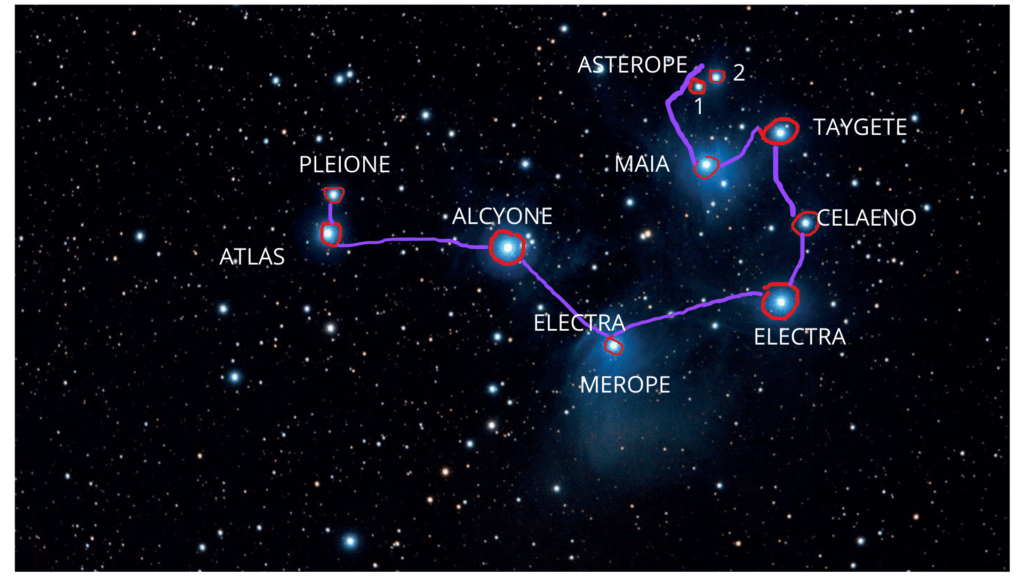
For the Apaza the Hanaq Pacha represents the world of the starts mama Chaska, the Pleiades or mama Qoto that are 7 ñustas, the music, as well as other constellations understood in the Andean world but also those that we do not know and are beyond, the Uqhu pacha the world inside, the underworld, where life arises to which we return after death. And the Kay pacha the land surrounded by the sea, the visible world (Szemiński, 2018).

Be that as it may it is one of the missions of the Andean tradition to remind today’s modern society the trinitarian idea is of vital importance, which according to Panikkar (1998) are guidelines of the given reality.

Where man is not enough, he needs other worlds to be able to realize his life in a better way. In this way we get as close as possible to the sense of the human being and his relationship with the cosmos and God.

Author: Joan de la colina Román


References:

  • Szemiński, J., Ziółkowski, M. S., y Wachtel, N. (2018). Mitos, rituales y política de los incas (R. Zeballos Rebaza, Trad.; Primera edición). Ediciones El Lector.
  • Brosseder, C. (2018). El poder de las huacas: Cambios y resistencia en los Andes del Perú colonial (R. Zeballos Rebaza, Trad.; Primera edición). Ediciones El Lector.
  • Panikkar, R. (1998). La Trinidad: Una experiencia humana primordial. Ediciones Siruela.
  • Favaron Peyón, P. M. (2023). La cristiandad de pariacaca: Pedagogía y sincretismo en el Manuscrito de Huarochirí. Kipus: Revista Andina de Letras y Estudios Culturales, 54, 57-78. https://doi.org/10.32719/13900102.2023.54.4

Brief history of the Q’ero Nation

Posted on

Rural Communities

When we talk about the Q’ero Nation, we refer to the territory that includes the rural communities of:

  • Japu
  • Quico
  • Marcachea
  • Qero Totorani
  • Hatun Q’ero

All of which are located in the Andes mountain range in the province of Paucartambo, southeast of the city of Cusco.

Geography

The geography of the place is abrupt with glaciers, inter-Andean valleys and jungle brow areas. The maximum altitude is 5600 and the minimum 1400 meters above sea level (Irco vilca, 2016).

Q’ero Nation Importance

The importance of the Q’ero for the Peruvian culture was given thanks to the Cusquenian anthropologist Oscar Flores Ochoa.

He refers Núñez del Prado (2005) that: “in 1949 in the festivities of Paucartambo Oscar observed the presence of some men, who despite sharing the humble poverty of the other peasants kept a composure of unusual dignity”(p,18).

These men claimed to come from the Q’ero hacienda, from this moment he decided to make an expedition to this place.

When he arrived at the hacienda, he realized that they still conserved customs and traditions that could be traced back to the Inka period, regarding agriculture, llama and alpaca herding, textile art, social organization and their spiritual customs.

Also at this time, the indigenous communities in the Andes were exploited by the hacienda system, suffering abuses and injustices. The Q’ero also had to go through this, being rented to employers in the haciendas of Cusco (Núñez del Prado, 2005). Thanks to Oscar and other factors that influenced the agrarian reform, the peasants began to take possession of their lands.

Myth of Q’ero Inkarri

In Q’ero we found the famous myth of Inkarri that in a few words refers to the transforming force that promotes order instead of chaos (Getzels, 2005). As well as the philosophy of life as the spiritual sense of Pachamama, the Apus as guardians of human wellbeing, among many other information concerning the philosophy and religion of Andean man.

That is why this town keeps strong elements of a tradition that comes from many years ago.

From the 80’s onwards many of the Q’ero came down from their community to work especially in offerings and other jobs.

Currently many of the Q’eros went to cities like Cusco and other provinces, to seek education and better economic future for their families keeping with them the Andean life wherever they go.

Author: Joan Rukmali De la colina Roman


References:

  • Flores, J. (2005). Los q’eros. Últimos descendientes de los incas. En J. Flores, J. Núñez del Prado y M. Castillo (Eds.), Q’ERO, el ultimo ayllu inka.
  • Peter Getzels (2005). Los ciegos: visión de la identidad del runa en
la ideología de Inkarrí-Qollam En J. Flores, J. Núñez del Prado y M. Castillo (Eds.), Q’ERO, el ultimo ayllu inka.
  • Irco Vilca. Mirtha (2005). La cultura como recurso económico: caso Q’ero (2005-2010). Tesis UNSAAC.

The Andean man – Children of the sun

Posted on

The Andean man involves exploring the cultures of the Andes. From the Pacific coast to the foothills of the tropical mountains.

Once again invoking the experts of these Andean cultures, we will encounter various human groups leading up to the emergence of the higher societies and cultures known as the “children of the sun.”

The magnificence of these Andean cultures is that in their birth, growth, and decline, they did not experience a radical break or complete disappearance.

On the contrary, future generations transmitted and preserved the essence of their knowledge. Even today, many of these practices and teachings remain relevant, adapting to the paths of this century.

Throughout these eras, a common spirit united the Andean man, always revered in the land as his mother.

This is why we have found in many of their material remains a symbolic continuity and iconography that transcend time and space.

These seeds germinated in various Andean communities, bearing fruit for the children of the Sun to harvest as they sought to plant new seeds while forming the great empire of Tawantinsuyu.

However, all of this was cut short when the new god, the white man, arrived.

The new era for the Andean Man

We are in the tenth Pachakuti, a time of transition and great change. Our children and this generation will be the architects of this new world. They’ll respect every living entity and raising the flag of the rainbow to consciously become the example of life for our fellow human beings.

The new Pachakuti features the significant presence of the mother. It represents the feminine aspect of the planet after 500 years of rest.

This does not mean the domination of women in the world. Rather, it emphasizes the need for the feeling of “mother” in our hearts.

With this feeling, we can reign with peace on earth.

This era of light that has already begun marks the harmonious balance between man and woman.

We will always have our differences, but we will strive to minimize them.

Men must yield to this new planetary vibration of the Mother.

We must feel that the magnetic feminine pole of our earth is now active, manifesting through the sacred lake Titicaca.


References:

Merejildo, J.A (1997). The awakening of the puma. An initiatory path. Astronomical evidence in the Andes. Chaski. Cusco, Perú.

Lightning in Andean Cosmology

Posted on

In the Andean worldview, lightning is a very important element. It serves as the messenger of the sky, announcing significant events in the lives of people.

People believed that lightning was the messenger of the sun.

In Hanan Pacha, people believed that the “auquis” struck with their slings, producing sparks that reached the earth.

The ray embodies the trinity, representing three distinct forces in a single phenomenon.

They call the zigzagging luminous sword “Kkjya,” the violent roar “Kkunnnnunnu,” and the flash “illapa.” Chroniclers report that for witches to exist, they needed the material and mystical imprint of lightning.

How to become an Auqui?

They become seers when struck by lightning or when they are infused with it during a storm, later specializing in the sacred.

The chroniclers also state that to become a sorcerer or sorceress, a person must be struck by lightning. If dead, be resurrected by another bolt, leaving significant physical marks and deformities—sacred signs to revere.

Family members and neighbors head to the site carrying white flags, and each person attending must bring something white.

They approach the deceased and observe:

  • If the person’s eyes look to the west, the family buries them immediately without ceremony, except for the customary prayers.
  • If the deceased’s eyes turn toward the east, it signifies a good omen. It indicates that the person has been chosen as an “auqui” and will protect their family.

Ceremony of Death by Lightning

When there is no Paqo for the ceremony, the oldest member of the group, assisted by the youngest, performs it. They conduct a ceremony and place various objects, such as a despacho mesa, coca leaves, and wrap them in a colorful uncuña.

Near the deceased, they open a grave and sprinkle it with liquor and chicha, asking the spirit not to neglect its family and friends. They place white flowers and more coca leaves in the grave.

They bury the deceased and place some clothing, personal belongings, and mementos on top. Then cover it with earth and place four white flags around the quadrangle, surrounded by white flowers.

Then, an instrument plays a melody while participants sing and share what remains of the liquor. Each participant places a large stone on the grave, forming a mound called Apacheta.

Singing and dancing, they move away, promising to return on the day of compadres with food, drink, and clothing. Participants must make this visit for three years to ensure the communal benefits become a lasting reality.


References:

Candia M, C. (1997) Popular Andean Medicine. Andean Books N°15.

Sanchez Macedo, M.O. (1998) Machu Picchu of the Priestesses, Witches, and Seers. Imprenta HGT S.R.Ltda.

The Tawantinsuyu

Posted on

The Tawantinsuyu, during the Inca period, integrated many ethnic groups spread across Ecuador, Colombia, Chile, and Argentina into its kingdom.

Inti illuminated the Andes in its four dimensions, and we saw the sacred Kúntur soar above the rainbow. The Children of the Sun became one with Wiracocha and Pachamama.

  • Collasuyo: Located to the southeast of Cusco, this Suyo was the largest in Tawantinsuyu but had the smallest population. Its territories began in Urcos, south of the imperial city, and extended through the Titicaca region.
  • Contisuyo: From the southwest of Cusco to the coastal region, the territories of Contisuyo comprised lands between the valleys of the Quilca and Ica rivers.
  • Chinchaysuyo: Chinchaysuyo extended to the northwest of Cusco, from Ayacucho and Ica to the Ancasmayo River.
  • Antisuyo: The lands of Antisuyo began to the northeast of Cusco and stretched to the High Jungle of the Amazon, as the climatic conditions and geographical features prevented further expansion.

The Tawantinsuyu

At the end of the Eighth Pachacuti, the visionaries of the Sun Empire spread the name of Wiracocha to the four corners of the earth. They universalized a common language among all peoples and leaving their eternal voice in the stones as a message for future generations.

The major expansion of the empire began with the presence of King Pachacuteq.

  • Tawa: Four, the four directions, four elements.
  • Inti: Sun, Father of Life, King Star.
  • Suyu: Land, region.
  • Tawantinsuyu: The four regions of the sun, the four lands of the sun.

How many Incas existed in Tawantinsuyu?

A total of 13 Incas ruled Tawantinsuyu, with Manco Cápac as the first and Atahualpa Cápac as the last, following the arrival of the Spaniards on the continent.

Pachacuteq Yupanqui, the ninth Inca, was one of the most important emperors in the history of Tahuantinsuyu due to his efforts in expanding the Inca territory through the conquest of other ethnic groups such as the Ayarmacas, Chancas, and Suyos.

At the same time, other peoples joined the empire peacefully, including the Cotanera, Omasayo, Cotapampa, and Aimarae.

Inca Pachacuteq ordered the construction of the legendary Inca citadel of Machu Picchu, one of the great legacies of Inca culture in Latin America, which still attracts thousands of tourists daily.

Initially, it was thought that the ruins of Machu Picchu served as a fortress, but years of research have concluded that it was a place of rest and meditation for the Inca and his family.


Today, the streets of Cusco are filled with Inca history and remnants of the impressive Tahuantinsuyu Empire, such as the Coricancha Temple, the main Inca temple, Sacsayhuamán, and Tambomachay, among others. Additionally, Machu Picchu represents a unique energy, history, and beauty that everyone should experience.


References:

  • Merejildo, J.A (1997). The awakening of the puma. An initiatory path. Astronomical evidence in the Andes. Chaski. Cusco, Perú.