
In Andean spirituality, Faith grows through relationship rather than belief, emerging from sustained engagement with land, cycles, and unseen forces (Allen, 2002).

Faith as Relationship, Not Belief
In Andean spirituality, faith is not an abstract belief system nor a mental act of conviction. It is a relational practice, a way of engaging with life through trust, reciprocity, and patience.
To “have faith” does not mean to hope blindly, but to enter into relationship with forces that are not immediately visible, yet profoundly present.

This understanding emerges from a worldview in which humans are not separate observers of nature, but participants in a living, conscious world animated by kawsay, the vital energy that flows through all beings (Allen, 2002).
Faith, then, is not passive. It is something cultivated, much like a seed placed into the soil.
Sowing Without Seeing: Trusting the Cycle
In agrarian Andean societies, sowing always involves uncertainty.
Farmers place seeds into the earth long before any visible sign of growth appears. This act requires trust in Pachamama, the seasonal cycles, and the unseen processes occurring beneath the soil.
Spiritually, this agricultural logic extends to inner life. January, aligned with the rainy season in the Andes, is understood as a time when much is happening out of sight. Emotional shifts, dreams, grief, intentions, and prayers are “planted” during this period, even if clarity or results have not yet emerged.

To sow faith means accepting that not all growth is immediate, and that forcing visibility can damage what is still forming.
As Andean cosmology teaches, life unfolds through cyclical time, not linear progression (Urton, 1981).
The Role of Uncertainty in Spiritual Maturation
Unlike traditions that frame uncertainty as a problem to be solved, Andean thought recognizes uncertainty as a necessary condition for transformation. The unseen is not empty; it is fertile.

Moments of not-knowing, emotional ambiguity, spiritual silence, or lack of direction are understood as thresholds rather than failures.
These states correspond to Uku Pacha, the inner or subterranean world where gestation, memory, and ancestral forces reside.
Faith grows precisely here: not through control, but through endurance and listening.
Ayni and Faith: Reciprocity With the Invisible
Faith in Andean spirituality is inseparable from ayni, the principle of sacred reciprocity. Trusting the unseen does not absolve one from responsibility; instead, it demands ethical engagement.
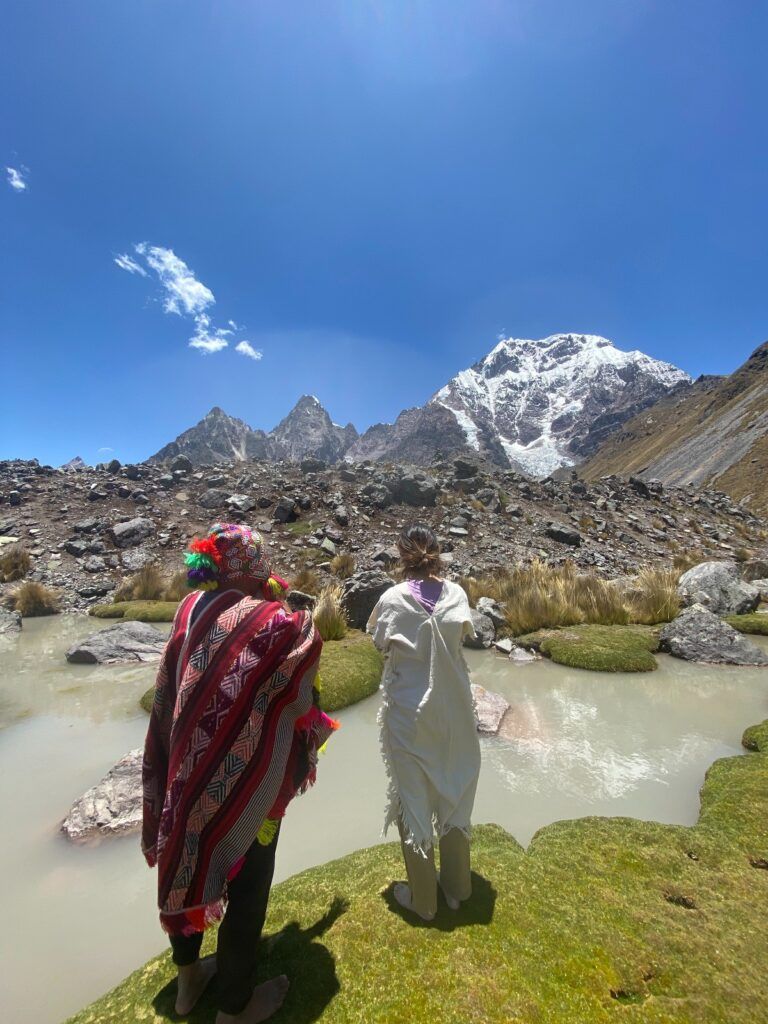
When one offers prayer, care, or ritual attention without demanding immediate outcomes, one participates in ayni with the invisible world.
This reciprocity maintains balance and prevents the accumulation of hucha, heavy or stagnant energy caused by impatience, force, or disconnection (Apffel-Marglin, 2012).
Faith is thus relational accountability, not wishful thinking.
January as a Month of Inner Planting
Within the Andean calendar, January is not a time of beginnings in the Western sense.
It is a time of incubation.
Rain softens the land, emotions intensify, and the boundary between inner and outer worlds becomes more permeable.
Sowing faith during this month means:
- Allowing feelings to move without demanding resolution
- Honoring dreams without immediately interpreting them
- Acting gently while trusting deeper processes.
What is planted now will surface later, often months after the initial act of trust.

Faith as an Act of Humility
Ultimately, sowing faith requires humility. It acknowledges that humans do not command life, but cooperate with it. The unseen is not something to conquer or illuminate prematurely, but something to respect.
Andean spirituality reminds us that life knows how to grow itself, provided we do not interrupt its rhythm.
To sow faith is to walk forward without certainty, yet never without relationship.
References
- Allen, C. J. (2002). The hold life has: Coca and cultural identity in an Andean community. Smithsonian Institution.
- Apffel-Marglin, F. (2012). Subversive spirituality: How rituals enact the world. Oxford University.
- Urton, G. (1981). At the crossroads of the earth and the sky: An Andean cosmology. University of Texas.