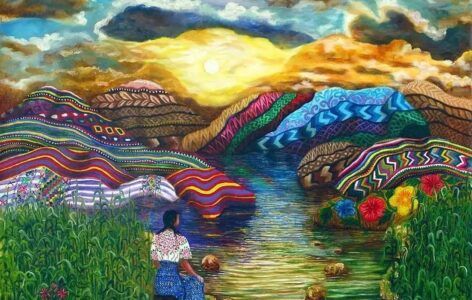
As March progresses, the Andean landscape continues to transform, in movement. What first appeared as fragile emergence now begins to establish itself more firmly. Plants extend their leaves, roots deepen into the soil, and growth becomes more visible across the fields.

This shift signals not only the continuation of life, but the return of movement.
After the stillness and containment of previous months, life begins to move outward. Yet this movement does not arise from urgency or force. It emerges from processes that have already matured beneath the surface.
Movement as a Relational Process
In Andean cosmology, movement does not belong to a single being. It unfolds through relationships, between soil, water, sunlight, and human care. Each element participates in the unfolding of growth.
For this reason, movement must remain in right relationship.

When plants grow, they do so in response to the conditions that surround them. When people act, their actions also take place within a network of relationships that shape outcomes.
Movement that ignores these relationships risks creating imbalance. Movement that respects them supports continuity.
Action Without Disruption
As growth becomes more visible, the impulse to intervene or accelerate development may increase. However, Andean traditions emphasize that effective action does not disrupt what is already in motion.
Instead, action should support existing processes.

Farmers may adjust irrigation, reinforce soil, or clear small obstacles, but they do so carefully, without interfering with the natural rhythm of growth. Their actions respond to what is already happening rather than imposing an external direction.
This approach reflects a form of movement grounded in attentiveness rather than control.
Learning the Timing of Movement
Movement requires timing. Acting too early can interrupt development, while acting too late may allow conditions to deteriorate. March teaches the importance of recognizing when movement becomes appropriate.
This recognition develops through observation and experience.
By remaining attentive to subtle changes in the land, people learn when to act and when to wait. Movement, therefore, becomes a skill shaped by relationship rather than impulse.

Walking Forward With What Is Growing
As the season advances, both land and people begin to move more actively. Yet this movement remains connected to what has already been established. Growth continues because it is supported, not because it is forced.
To move in right relationship means walking forward with awareness of the conditions that sustain life. It means recognizing that every action participates in a larger process.
In this way, movement becomes not only an expression of growth, but a continuation of the relationships that make growth possible.
References
- Allen, C. J. (2002). The hold life has: Coca and cultural identity in an Andean community. Smithsonian Institution Press.
- Urton, G. (1981). At the crossroads of the earth and the sky: An Andean cosmology. University of Texas Press.
- Gose, P. (1994). Deathly waters and hungry mountains: Agrarian ritual and class formation in an Andean town. University of Toronto Press.
This article draws on both academic literature and oral, lineage-based Andean knowledge. Teachings that originate from living traditions are cited in recognition of their ongoing transmission within Andean communities, while scholarly sources are used to support contextual interpretation.