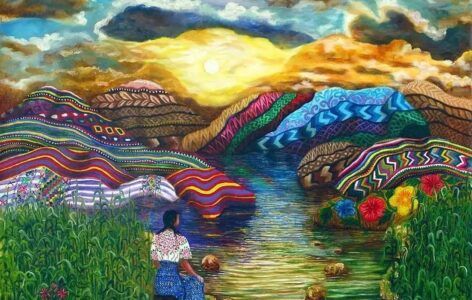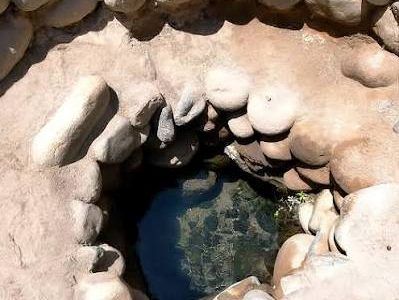
In the Andes, language is not merely a tool for communication; it becomes a living bridge of relationship between human beings and the cosmos. A Quechua word can carry more than a definition. It can hold memory, place, experience, and the traces of generations who learned to listen to the movements of the world around them.
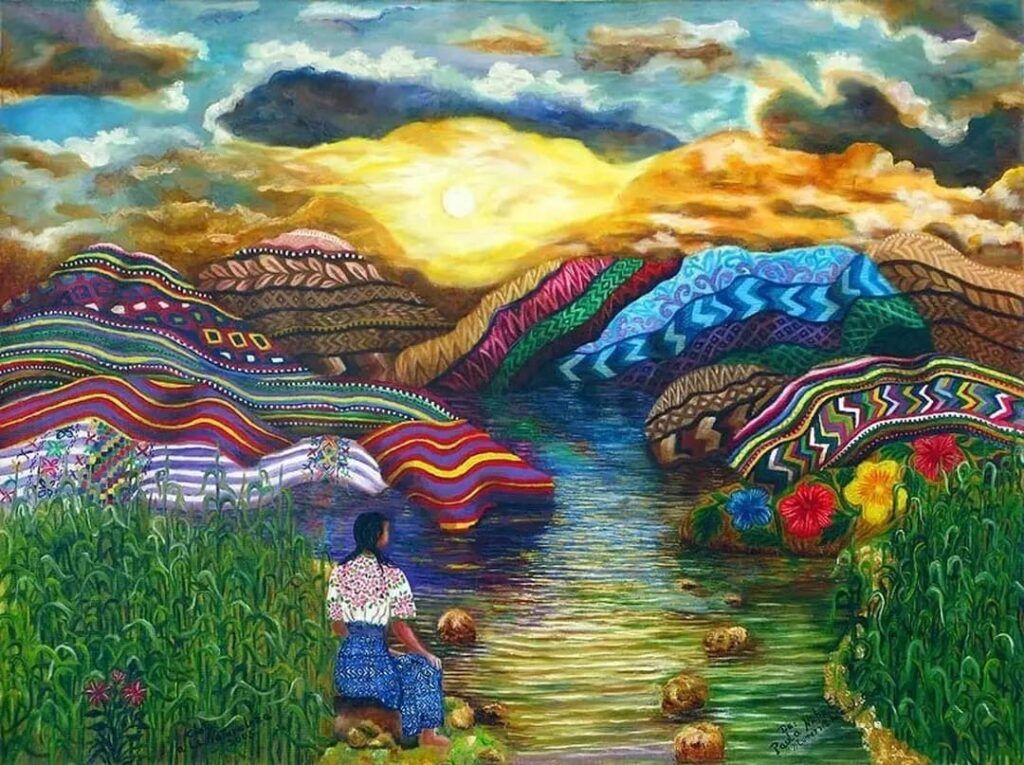
Within this worldview, words can become vessels of ancestral knowledge. They carry echoes of mountains, rivers, winds, stars, and the changing seasons. A word spoken with intention may recall not only an object or an action, but a relationship, a way of standing within the living world rather than outside it.
When Quechua Carry Ancestral Memory
Quechua language therefore invites a different way of listening. Its meanings emerge through the relationships that surround them: between people and the land, between visible and unseen dimensions, between what is spoken and what remains understood through experience. The language does not simply describe the world; within living traditions, it can help people remember how to relate to it.

For generations, Andean communities have observed the subtle movements of nature: the arrival and retreat of rain, the behavior of the soil, the changing position of the stars, the rhythm of the Moon, and the transformations of the landscape. These observations became intertwined with stories, practices, ceremonies, and words passed from one generation to another.
In this sense, language becomes a form of ancestral memory.
A Quechua term may open a doorway into a much larger field of meaning, one where the spoken word meets the landscape, where memory meets experience, and where knowledge remains inseparable from relationship. What appears to be a simple word can therefore become an invitation to listen more deeply.

To speak Quechua within a living Andean tradition is not simply to name what exists.
It can also be a way of remembering that we belong to what we name.
The eight essential Quechua terms
1. T’inkay (The Ritual Libation)
- Meaning: To sprinkle sacred liquid (chicha, water, or wine) onto the soil before starting any agricultural work.
- Spiritual Context: A ritual act of respect and greeting to Pachamama, asking her permission before disturbing or turning the earth.
2. Muyu (The Seed / The Spiral of Time)
- Meaning: Seed; also refers to a circular motion or evolutionary spiral.
- Spiritual Context: A seed is not seen as an inert object, but as a living vessel containing latent life force (kawsay). It also reminds us that time moves in cycles, not straight lines.
3. Chakrayukuy (Preparation of the Field)
- Meaning: The formal opening and clearing of the agricultural plots (chakras).
- Spiritual Context: Preparing the field involves both physical clearing (removing stones and weeds) and energetic clearing (releasing heavy hucha from the land).
4. K’intu (The Sacred Coca Leaf Trio)
- Meaning: Three intact, unblemished coca leaves arranged fan-like in the fingers.
- Spiritual Context: Used as a focal point for prayer, intention, and breath (phukuy) to offer gratitude to the mountain spirits (Apus) and Mother Earth before planting begins.
5. Unkuña (Sacred Ceremonial Cloth)
- Meaning: A small, square handwoven textile used to hold sacred objects, coca leaves, or seeds during rituals.
- Spiritual Context: The textile represents protective space and boundary, keeping the seeds grounded in sacred intention before they enter the soil.
6. Sarpay (The Act of Sowing Intention)
- Meaning: Placing seeds into the earth with ritual care.
- Spiritual Context: Sowing is done with conscious intention; what you hold in your heart while placing the seed into the ground influences the quality of the harvest.
7. Minka (Collective Community Work)
- Meaning: Organized community labor dedicated to shared projects, such as clearing communal irrigation canals or tilling large fields.
- Spiritual Context: While ayni is direct one-on-one reciprocity, minka is collective reciprocity that builds community strength (ayllu).
8. Allin Kawsay (Harmonious Living)
- Meaning: Living well; being in right relationship with oneself, community, nature, and the spiritual world.
- Spiritual Context: The ultimate goal of all seasonal rituals and agricultural practices, maintaining alignment across all realms of existence.
References
- Allen, C. J. (2002).The Hold Life Has: Coca and Cultural Identity in an Andean Community (2nd ed.).
- di Salvia, D. (2018).Contribución a la ontología animista andina: Funciones, poderes y figuras en los cultos telúricos de los Andes sur-peruanos. Revista Española de Antropología Americana, 48, 219–242.
- Urton, G. (1981).At the Crossroads of the Earth and the Sky: An Andean Cosmology.
This article draws on both academic literature and oral, lineage-based Andean knowledge. Teachings that originate from living traditions are cited in recognition of their ongoing transmission within Andean communities, while scholarly sources are used to support contextual interpretation.