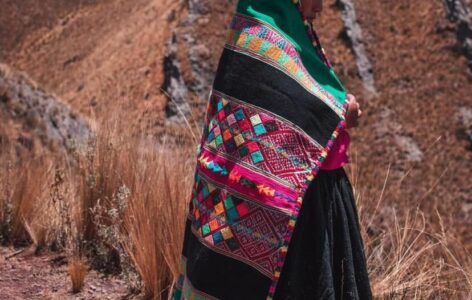
September opens a different quality of relationship with the Andean world, this is the Living Reciprocity. The season approaches the spring equinox, while the historical Andean calendar associates this period with Qoya Raymi, a celebration connected with the feminine sphere, the Moon, and ceremonial life.

Rather than treating this transition simply as a change in weather or season, Andean cosmology allows us to contemplate how human beings participate in the cycles that surround them. The world does not exist as a passive landscape. People interact with mountains, waters, celestial bodies, animals, plants, and the land through relationships that carry obligations as well as meaning.
Living Reciprocity Beyond Exchange

The Quechua concept of ayni provides one important expression of reciprocal relationships in the Andes.
Researchers have documented reciprocity not merely as an economic exchange, but as a principle that organizes social relationships and community life.
To understand reciprocity in this context, we must move beyond the idea of simply giving something in return for something received:
- Reciprocity establishes relationship: When someone gives, they acknowledge another person’s presence and contribution.
- Reciprocity creates continuity: When someone receives, they recognize that their existence depends partly on others, connecting people, communities, and the wider world.
Pachamama and the Ethics of Receiving
Andean relationships with Pachamama illustrate this principle particularly clearly. Historical and ethnographic research documents offerings and other forms of ritual engagement with the earth in Andean communities. These practices express recognition of the land as an active participant in human life rather than merely a source of resources.
From this perspective, receiving food, water, nourishment, or protection creates a responsibility to respond. Reciprocity becomes an ethical orientation, asking us to consider not only what we receive from the world, but also what our presence contributes to it.

“What matters is not mathematical equivalence, but the recognition that every relationship asks for participation.”
The Sacred Web of Relationship
Andean cosmology places human beings within a wider relational field. The land, mountains, celestial bodies, and other beings participate in systems of meaning that connect the visible and invisible dimensions of existence.
Research on Andean cosmology describes how communities understand environmental elements and places as participants in social and symbolic relationships rather than as inert objects. This perspective changes the fundamental question from “What can I receive from the world?” to “How do I participate in the relationship that sustains me?”
The September Equinox and Returning to Balance
The equinox offers a powerful image for this relational understanding. Light and darkness meet at a point of seasonal transition, reminding us that life continuously moves between different conditions.
Within a contemporary spiritual interpretation, the equinox invites us to examine our own relationships through reciprocity:
- Where have we received without acknowledging?
- Where have we given without allowing ourselves to receive?
- Where have our relationships lost their balance?
The reciprocity of the season invites us to restore connection rather than simply seek equilibrium within ourselves.
The Feminine Dimension of Living Reciprocity
September’s association with Qoya Raymi creates another important layer. Recent scholarship examines the festival in relation to the political and symbolic role of the qoya, demonstrating that the feminine sphere held significance within Inca ceremonial and social organization.
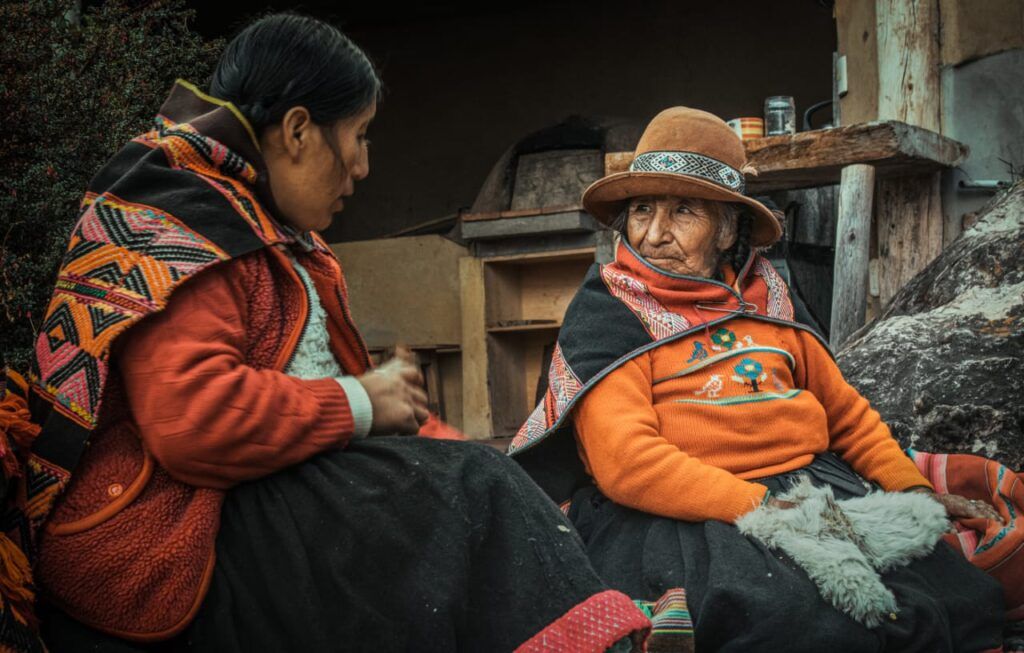
This historical dimension enriches contemporary spiritual reflection without reducing the feminine to a single symbolic definition. The feminine can represent a capacity to receive while remaining powerful, to nurture without becoming passive, and to sustain relationships through attentive participation. In this sense, reciprocity describes a living circulation rather than a one-directional movement.
Giving Back Without Erasing What Was Received
Reciprocity does not require us to return exactly what we received:
- The land gives nourishment, while people respond through care.
- A teacher gives knowledge, while the student carries that knowledge forward.
- A community provides support, while its members contribute their presence and abilities.
This flexibility allows reciprocity to remain relational rather than transactional.
Living Reciprocity as Spiritual Practice
A spiritual practice rooted in reciprocity begins with attention:
- Before giving, we recognize what sustains us.
- Before receiving, we recognize the relationship through which something reaches us.
- Before asking, we consider how we participate in the larger cycle.
This orientation transforms gratitude from an emotion into a practice, encouraging responsibility toward people, places, and the living world.
Returning to the Relationship
September reminds us that every cycle contains movement in both directions. Something arrives, something is received, and something returns.
When we return what we can, through care, gratitude, attention, service, or respect, we do more than complete an exchange. We keep the relationship alive.

References
- Allen, C. J. (2002). The hold life has: Coca and cultural identity in an Andean community (2nd ed.).
- Baulenas i Pubill, A. (2025). El Coya Raymi y la esfera de poder femenino en el incanato. Chungará (Arica), 57, e02625.
- di Salvia, D. (2013). La Pachamama en la época incaica y post-incaica: Una visión andina a partir de las crónicas peruanas coloniales (siglos XVI-XVII). Revista Española de Antropología Americana, 43(1), 89–110.
- di Salvia, D. (2018). Contribución a la ontología animista andina: Funciones, poderes y figuras en los cultos telúricos de los Andes sur-peruanos. Revista Española de Antropología Americana, 48, 219–242.
- Urton, G. (1981). At the crossroads of the earth and the sky: An Andean cosmology.
This article draws on both academic literature and oral, lineage-based Andean knowledge. Teachings that originate from living traditions are cited in recognition of their ongoing transmission within Andean communities, while scholarly sources are used to support contextual interpretation.