
September brings the Andean calendar to a profound astronomical and spiritual threshold. The September equinox marks the precise moment when the Sun crosses the celestial equator, producing nearly equal periods of daylight and darkness across the globe. In the Southern Hemisphere, this transition accompanies the gradual, decisive awakening of spring.

In this second installment of our September series, our focus keyword is September equinox. We explore how this astronomical event offers far more than a celestial measurement, it serves as a sacred threshold through which we can contemplate balance, dynamic transition, and our evolving relationship with the cosmos.
The Equinox as a Sacred Threshold
For the Inca, astronomical observation was never an isolated scientific discipline separated from daily life. Research in archaeoastronomy demonstrates that tracking the Sun’s position along the mountain horizon directly informed calendrical, agricultural, and ceremonial practices. Historical sources and modern scholarship consistently link Qoya Raymi with the September equinox within the Inca ceremonial calendar.
Past
Winter Darkness
Reflective internal work, root development, and rest.
<<<<<<<<<<<<<<
EQUINOX THRESHOLD
>>>>>>>>>>>>>>
Future
Spring Light
Active agricultural expansion, outward expression, and growth.
Between Darkness and Light: Equinox as Complementarity
The September equinox brings light and darkness into a temporary, delicate balance.

Rather than understanding this equilibrium as a rigid or static state, Andean cosmology invites us to see complementary forces participating in a dynamic, living relationship (Yanantin).
Day does not eliminate night, and night does not oppose day; each gives meaning, context, and definition to the other.
The September equinox represents a moment of correspondence rather than conflict.
This distinction is vital when approaching Andean concepts of duality:
- Non-Binary Balance: Complementarity describes relationships where distinct dimensions maintain and support each other through continuous interaction.
- Movement Within Stillness: The objective is not to remain frozen in the middle, but to recognize when a particular energy requires our active attention and when another needs space to emerge.
The Wisdom of the Liminal Space
The September equinox does not belong entirely to the cycle that came before, nor to the cycle that unfolds next, it stands between them. This liminal quality makes September particularly meaningful within a spiritual reading of the Andean year.
Questions at the Threshold
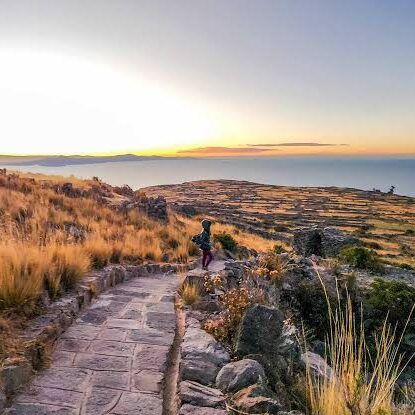
At a threshold, perception becomes exceptionally clear. The equinox invites us to pause between cycles and observe our inner landscape before rushing toward what comes next:
- What am I carrying forward from the previous cycle that still serves my path?
- What has completed its function and is ready to be released back to Mother Earth?
- What requires my quiet attention before the next active phase begins?
“Balance does not mean the absence of change. It means learning how to move through change without losing relationship.”
Linguistic Portal: The Language of the Equinox
- September Equinox: The celestial crossing marking equal daylight and night, signaling the spring shift in the Southern Hemisphere.
- Yanantin: The foundational principle of dynamic, complementary duality where opposing forces sustain the whole.
- Pacha T’ikray: A point of cosmic turning, seasonal transition, or realignment within a natural cycle.
Sacred Topography: Monuments of Solar Alignment
To understand how ancestral builders mapped the September equinox into carved stone, two key archaeological sites illustrate this union of astronomy and sacred architecture:
- The Intihuatana of Machu Picchu: Carved out of a single bedrock outcrop, this sacred stone served as an astronomical clock and solar alignment monument during equinoxes and solstices.
- The Sun Temple of Pisac: Situated high above the Sacred Valley, its curved stone masonry aligns with equinox solar horizons to guide agricultural planning.
References
- Baulenas i Pubill, A. (2025). El Coya Raymi y la esfera de poder femenino en el incanato. Chungará (Arica), 57, e02625.
- Gullberg, S. R. (2019). Inca astronomy: Horizon, light, and shadow. Astronomische Nachrichten, 340(1–3), 23–29.
- Urton, G. (1981). At the Crossroads of the Earth and the Sky: An Andean Cosmology.