
In the heart of the Andes, complementarity is not achieved by erasing differences, but by honoring them. The ancient wisdom of the Yanantin and Masintin teaches that opposites are not enemies, but sacred partners in the dance of creation.

This understanding lies at the core of the Andean worldview, a vision of the cosmos where everything exists in relationship, where harmony is not sameness but dynamic equilibrium.
The Origin of Duality in the Andean Mind
In many philosophical systems, duality is viewed as a conflict, light versus dark, male versus female, good versus evil. Yet in the Cosmovision Andina, duality is a creative tension, an interplay that sustains life itself. The Quechua word Yanantin comes from yana, meaning “pair” or “counterpart,” and -ntin, a suffix indicating unity or togetherness. Masintin, its complement, means “the one who mirrors or completes.”

Together, Yanantin-Masintin describe a living polarity, two forces distinct but interdependent, continuously moving toward reconciliation. As the anthropologist Catherine Allen (2002) notes, Andean thought “does not strive to resolve opposites but to maintain them in fruitful coexistence.”
The Universe as a Web of Complementarity
To the Andean mind, the universe is woven from relationships, not isolated entities. Mountains and rivers, sun and moon, masculine and feminine, all are expressions of a single living energy known as Kawsay. This energy flows through Ayni, the principle of reciprocity that governs all interactions.

Yanantin exists within Ayni: each pole gives and receives, supports and challenges the other. The farmer depends on the rain; the rain depends on the Earth’s breath; both depend on the human who honors them through ritual. In this way, balance is not static but rhythmic, a conversation between energies.
When this relationship is forgotten, imbalance and illness arise. Healing, therefore, is the art of restoring complementarity, within the self, between people, and between humanity and nature.
The Dance Within the Self
On a personal level, Yanantin-Masintin manifests as the union of inner opposites, reason and intuition, activity and rest, spirit and matter. In Western psychology, this mirrors the integration of the conscious and unconscious, or the animus and anima described by Carl Jung. Yet in the Andes, this union is not only psychological; it is energetic and sacred.

Every human carries both warm and cool energies, masculine (ch’unchu) and feminine (qhari-warmi). When these currents are in harmony, we experience coherence, clarity, and peace. When they are divided, we fall into confusion or fragmentation. The Andean priest, or Paqo, cultivates the ability to hold both, to become the space where opposites meet and transform into wholeness.
This inner work is not about control but about listening, allowing each energy to express its wisdom. The soft teaches the strong how to yield; the strong teaches the soft how to stand. Together, they generate the creative pulse that sustains life.
Nature’s Mirrors of Complementarity
The natural world constantly reveals the principles of Yanantin and Masintin.

The mountain (Apu) stands firm, while the lake (Mama Qocha) reflects and receives.
The sun radiates light, the moon gathers and returns it. The condor soars in the upper world, while the serpent glides through the underworld — both necessary to maintain the balance of realms.
In Andean agriculture, this principle governs planting cycles: dry and wet seasons, seed and fruit, night and day. Farmers do not resist these rhythms; they align with them, honoring each phase as essential. To live according to Yanantin-Masintin is to understand that harmony is born from relationship, not control.
Complementarity Reflected in Nature
In Andean healing, imbalance is often seen as the result of separation, a break in reciprocity or mutual recognition.
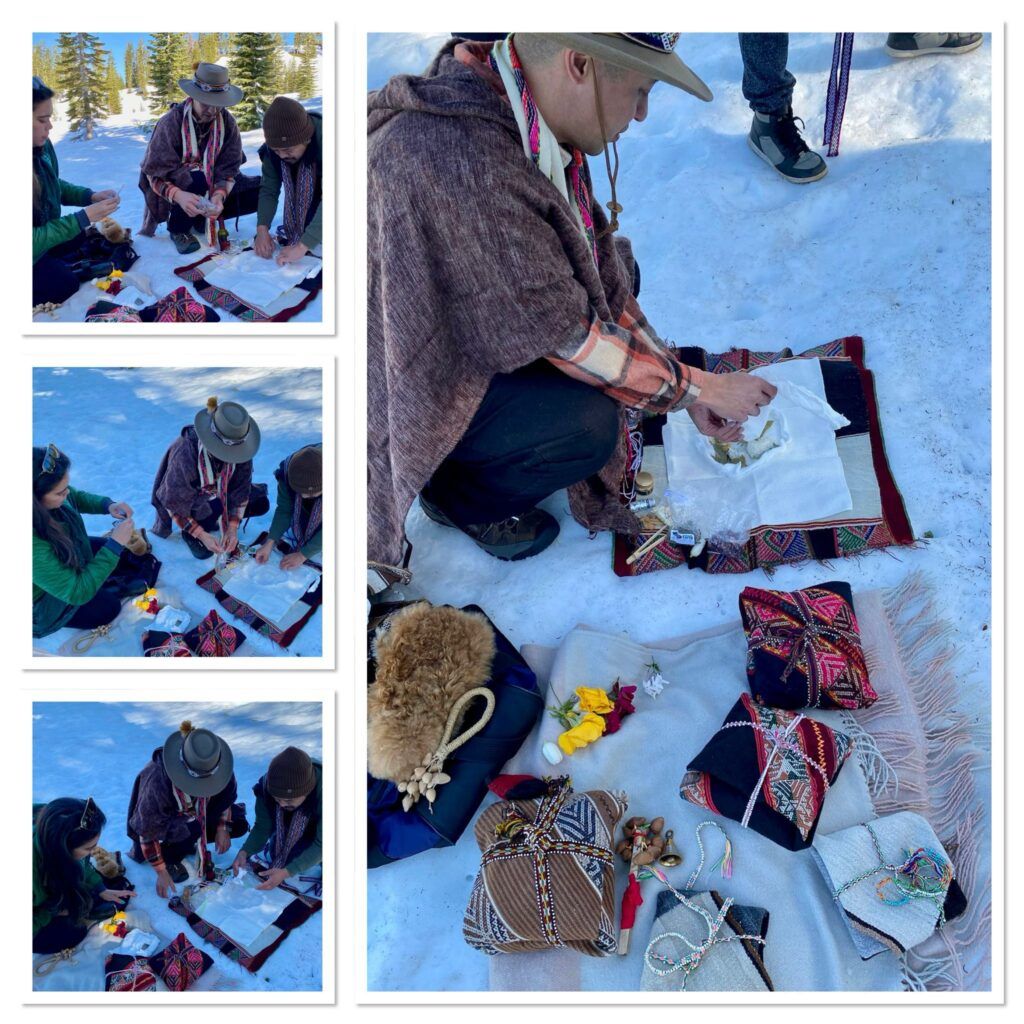
A healer restores harmony by reuniting what was divided: the person and their lineage, the individual and the land, the mind and the body. Rituals such as the despacho offering embody this union, fire and earth, smoke and intention, prayer and material form, all dancing in sacred partnership.
The practitioner learns to become a bridge rather than a judge, to see the wound not as an enemy, but as a messenger of lost relationship. Through this lens, even illness becomes a teacher of complementarity, showing where love and awareness must return.
Beyond the Binary
In the Andean tradition, there is no final victory of light over darkness, both are necessary for life to exist. The goal is not to transcend duality, but to embody complementarity, to walk with awareness that every polarity is a gate to greater consciousness.

This wisdom offers a medicine for the modern world, where polarization has become epidemic. The Andes remind us that wholeness does not mean perfection; it means participation in the living dance of opposites. To be whole is to allow contrast, to embrace paradox, and to honor both the storm and the stillness it leaves behind.
The world was never meant to be divided. It was meant to be danced.
References
- Allen, Catherine J. (2002). The Hold Life Has: Coca and Cultural Identity in an Andean Community. Smithsonian Institution Press.
- Bastien, Joseph W. (1985). Mountain of the Condor: Metaphor and Ritual in an Andean Ayllu. Waveland Press.
- Medrano, Ricardo. (2010). Cosmovisión Andina y Sabiduría Ancestral. Editorial San Marcos.
- Inca Medicine School Teachings, oral tradition of Andean Paqos.