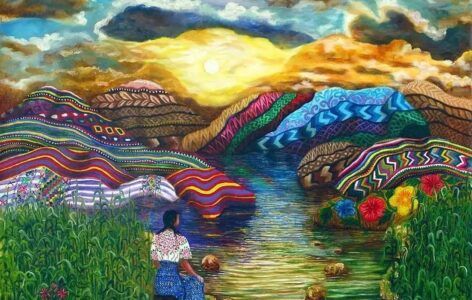
Beyond myth and ceremony, the Andean tradition also recognizes the Inner Sun, the sun within the heart. Every person carries a spark of divine radiance, known as Inti Ñawi which represents consciousness, clarity, and awakening.
To live in alignment with Inti is to walk in light, to act with integrity, to radiate warmth, and to honor the cycles of transformation that mirror the sun’s path from dawn to dusk.

The Inner Sun
Even today, Andean healers invoke Inti during ceremonies to illuminate heavy energies (hucha) and restore Kawsay in those seeking healing. In this way, Inti continues to shine through the human spirit, guiding those who walk the path of Munay.

In the Andean world, Inti, is far more than a celestial being. He is the living heart of the cosmos, the ever-present witness to life’s dance between light and shadow.
His warmth nourishes Pachamama, awakens the crops, and sustains the rhythm of existence.
Yet, beyond myth and ceremony, the Andean tradition also speaks of the Inner Sun, the radiant sun within the human heart.
The Eye of the Sun: Inti Ñawi and the Light of Consciousness
According to ancestral teachings, every person carries within them a spark of divine luminosity, known as Inti Ñawi, the Eye of the Sun. This is not a physical eye, but a center of perception, the point where Kawsay becomes self-aware.
To awaken Inti Ñawi is to open the inner vision that sees beyond duality and illusion. It is to remember one’s essence as a luminous being journeying through the cycles of day and night, ignorance and awakening.
In Andean cosmology, consciousness itself is light. When the Inner Inti shines clearly, it dispels confusion and fragmentation, guiding the individual back to wholeness.

One begins to recognize the self not as separate, but as a reflection of the cosmic sun, radiant, connected, and purposeful (Allen, 2002).
Walking in Light: Living in Ayni with the Inner Sun
To live in alignment with the Inner Inti is to walk in light. This path is expressed through the ethics of Ayni, the sacred reciprocity that governs all life. Just as the sun gives without asking, the awakened heart acts through Munay, unconditional love, radiating warmth, truth, and integrity in every gesture.

The person who embodies the solar essence becomes a carrier of light, illuminating others through compassion and clarity.
Yet this path is not about avoiding darkness. Like Inti, who descends into the underworld each night, we too must honor our inner dusk, the moments of grief, confusion, or loss. These passages through shadow are not punishments, but initiations into deeper wisdom. The Inner Sun does not destroy darkness; it transforms it into consciousness.
The Healing Power of Inti: Illumination and Renewal

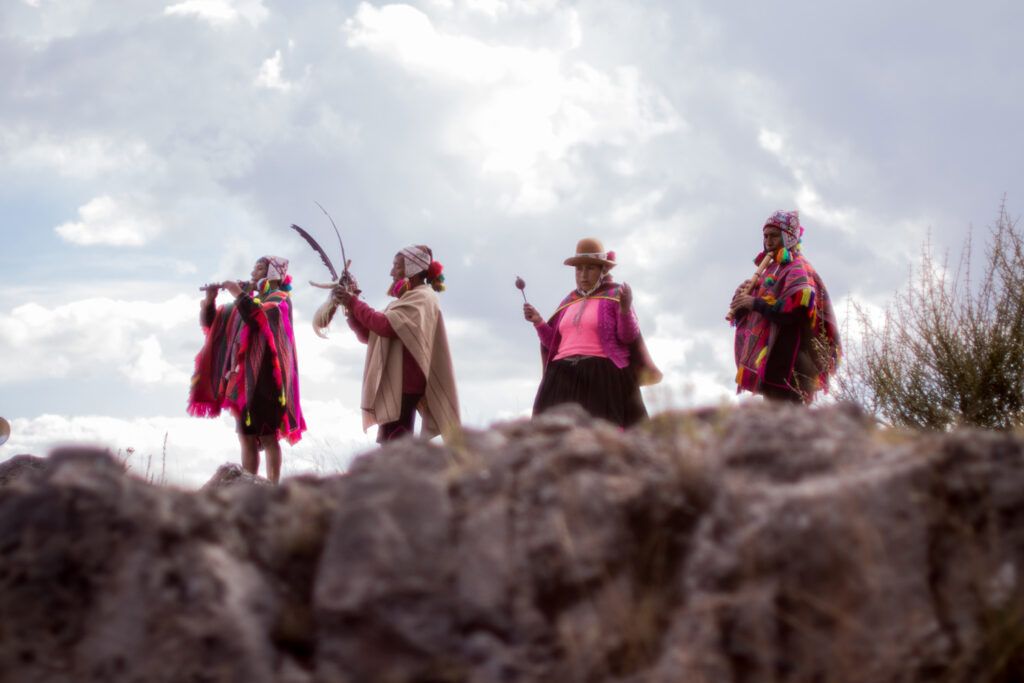
In contemporary Andean healing, Altomisayocs and Paqos still invoke Inti to illuminate hucha the dense energies that obscure the natural flow of Kawsay.
Through sacred breathwork, despacho offerings, and solar invocation, the healer calls upon Inti’s light to restore balance and harmony within the individual.
This process is both energetic and psychological: illumination becomes a return toclarity, vitality, and self-remembrance.
When one’s Inner Sun is awakened, life begins to flow again in the rhythm of Sumak Kawsay, the state of harmonious and radiant being (Bastien, 1985).
The Path of Munay: Becoming a Living Sun
Ultimately, the awakening of the Inner Inti is the flowering of Munay, the sacred love that arises from a heart aligned with truth. To live from Munay is to become a living sun, a being whose presence nourishes and enlightens others simply through being.
Every act of kindness, every breath of gratitude, becomes an offering to Pachamama and the cosmos. The Andean initiate understands that the dawn is not outside of us, it rises from within each time we choose awareness, compassion, and courage.
As the elders say:
“Wherever the Sun walks, the heart must follow.”
References
- Allen, Catherine J. (2002). The Hold Life Has: Coca and Cultural Identity in an Andean Community. Smithsonian Institution Press.
- Bastien, Joseph. (1985). Mountain of the Condor: Metaphor and Ritual in an Andean Ayllu. Waveland Press.