logo im

Ayllu and Panakas

Posted on

Welcome to our blog where we’ll explore how andean culture organized themselves around kinship and reciprocity, with the ayllu as their core unit.

Join us as we’ll uncover how social structures were shaped by ancestral reverence and dualistic moieties, and how senior lineages in the Inca Empire rose to prominence.


Ayllu

An ayllu is a sacred web of souls, bound together by the timeless threads of a common ancestor who wove their existence with the gifts of water and earth.

This ancestral figure bestowed upon them the sacred waters and fertile lands, the lifeblood upon which their existence flourishes.

They hold a profound belief that their very essence springs forth from these divine resources. Upon their departure from this earthly realm, they shall journey back to the embrace of Pachamama Mother Earth.

Ayllu Family

The ayllu represents the heart of their universe, with their relationship to their ancestors being central to their well-being and prosperity.

Andean belief understand that an ayllu can only be responsible for the care and veneration of a huaca if it’s directly connected to their lineage.

Ayllu in General

In pre-Hispanic Andean societies, people structured their lives around kinship and reciprocity, with households serving as the core socio-economic units.

They organized these households into larger groups called ayllus, defined by kinship ties and mutual cooperation.

Ayllus were more than social collectives; they established deep connections to specific lands through religious beliefs and historical presence.

The ayllu functioned as both a political and productive unit.

Often spanning multiple villages, they reflected significant influence within Andean culture.

Though ideally egalitarian with no formal political or religious institutions, the ayllu’s reality involved kinship-based hierarchies that introduced elements of inequality.

Practically, the ayllu functioned as both a political and productive unit, central to economic and organizational life.

The ayllu reinforced its identity and unity through distinctive clothing and ritual battles, underscoring its social cohesion and territorial importance.

Affinity as the Organizing Principle

In pre-Hispanic Andean societies, affinal relationships were fundamental to the structure and unity of ayllu groups.

Groups articulated membership and descent through both relational and ideological dimensions, highlighting the importance of kinship and shared heritage.

People determined seniority within an ayllu by their proximity to mythical founding ancestors. Typically, ayllus formed moieties, or saya, which ideally divided into two:

  • Hanansaya (senior)
  • Hurinsaya (junior)
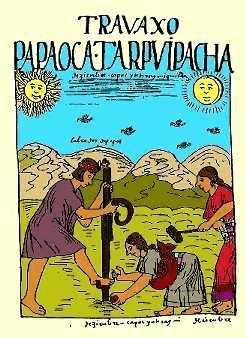
“Trabajo (Travaxos) de la papa y oca (papaoca) en la epoca de la siembra (tarpvi-pacha)” (Felipe Huamán Poma de Ayala)

The dualistic arrangement in Andean society reflected the broader concept of duality that permeated all aspects of life.

Ancestral reverence was vital, with ancestors regarded as powerful spiritual entities whose bodies and sacred sites received deep respect.

Ancestral rites were central to religious practices, aimed at harnessing spiritual forces and preventing misfortune.

Ritualized mock battles, or tinku, reinforced social order and distinctions.

Although these battles could cause injury, people saw them as essential sacrifices to maintain balance between the human and natural worlds.

Reciprocity as Social Practice

Mutual obligations were fundamental, with every member both receiving and providing benefits.

At the subsistence level, communal reciprocity drove agricultural production.

Reciprocity extended to administrative and religious duties.

Labor was shared, and in return, community support was provided for essential needs.

Senior members managed feasts and rituals as community obligations, with responsibilities rotating among individuals.

Shamans acted on behalf of the community in their interactions with the supernatural, fulfilling reciprocal responsibilities rather than seeking personal power.

Despite ideals of equality, redistribution of goods could be unequal, with moiety heads responsible for distributing resources, often keeping some for large feasts and festivals to assert their authority.

The Ayllu as Spiritual Community

Religion was integral to ayllu life, with rituals and spiritual practices addressing daily challenges and mobilizing natural and ancestral forces.

Religious practices closely linked to agricultural cycles, cosmological balance, healing, communal land ownership, settlement management, and overall community administration.

The panaka

The panakas, as part of Cusco’s aristocracy, upheld sacred shrines, performed rituals for their founder emperor, and preserved his memory through cultural practices.

The panaka was a special administrative unit in Cusco, designed to manage the city’s large population.

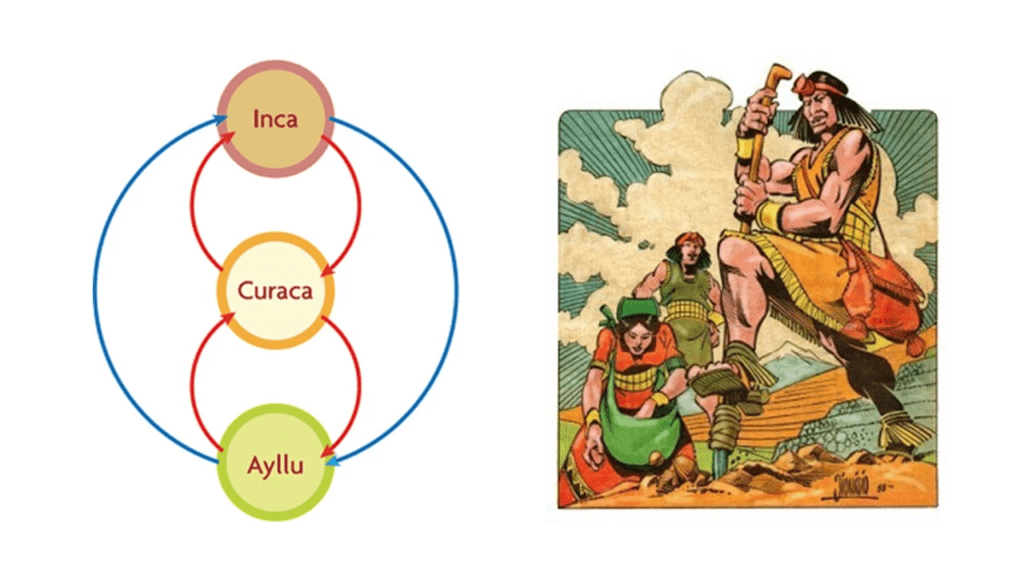
Modeled after the ayllu—a fundamental social unit in Andean society—the panaka served as a family clan connected to the Sapa Inca, the emperor of the Inca Empire.

Unlike the ayllu, which included all common people, the panaka reserved its membership for the royal family and excluded the auqui, the heir apparent.

Each panaka maintained its own traditions and historical records. In the ceque system, which symbolically organized the Inca Empire.

The Payan ceque represented the panacas and integrated them into the broader framework of regional divisions such as Hanan, Hurin, and others.

Ayllu and Panaka’s Political Organization

The ceque system also encodes the political organization of the Inca capital based on the material foundation of its existence: that is, the canals and lands of each panaka and ayllu that enjoyed the privilege of residing in Cusco.

The panakas, which were ayllus of the royal Incas, owned the best and most important canals and lands in the city, while the less important ones belonged to ayllus that were not of royal Inca descent.

Ceques Meaning

Posted on

Upon publishing the first Collasuyo system on the blog earlier, we received questions about what Huacas and Ceques are.

So, we decided to create a specific blog to explain these two important terms and systems in ancestral knowledge.

Even so, we realize that the information provided is not exhaustive, as there is extensive research available for those who wish to delve deeper into this topic and satisfy their curiosity.

We hope this blogs plants the seed of curiosity, serving as the beginning of new knowledge.


Ceques

According to the Quechua Language Academy, “ceq’e” means scribble or amorphous lines.

The ceques were lines radiating from Cusco, organizing the huacas or shrines around them, forming a complex religious spatial system known as the “Sacred Space of Cusco.”

These lines were intricately linked to geography, geometry, astronomy, and social groups.

Specific families from Cusco managed each ceque, overseeing several huacas or shrines and taking responsibility for their care and offerings.

The four royal roads

The shrines were distributed as follows:

  • Chinchaysuyo had 9 ceques with 85 huacas
  • Antisuyo had 9 ceques with 78 huacas
  • Contisuyo had 14 ceques with 80 huacas

Totaling 41 ceques with 323 huacas.

The ceques were lines radiating from Cusco like an bicycle wheel of radial organization.

The Incas used these principles with some additional refinements.

A panaka or ayllu always managed the ceques that included the huacas marking the water sources for Cusco‘s main canals (Sherbondy 1982).

Each group included a ceque of higher rank (Qollana), another of middle rank (Payan), and the last of lower rank (Kayao).

These organizational principles of the ceque system arranged the geographical space of the Cusco Valley in a radial form, with the Coricancha temple at its center, and simultaneously organized the economy by distributing the irrigation districts within the territories of the panakas and ayllus.

Lastly, they organized the religious obligations that served to reaffirm the rights of the panakas and ayllus to their waters and lands (Sherbondy 1982).

The Significance of Ceques

Integration into the Ceque System:

  • The Inca authorities incorporated the huacas into the official ceque system, creating a structured, ceremonial, and administrative framework.
  • This inclusion transformed huacas from purely spiritual entities into key components of political and civil governance.

Political and Civil Functions:

  • The selection of huacas for inclusion in the ceque system was a political act, influencing which ayllus (lineages or clans) were granted the privilege to reside in the capital city, Cusco.
  • The ceque system determined the distribution of resources and administrative control across the empire.

Ceque System and Irrigation Districts:

  • The ceque system aligned with the boundaries of irrigation districts, integrating spiritual and practical aspects of land management.
  • People placed ceques strategically according to the needs of the regions they demarcated, rather than following a geometric ideal.

Land and Water Rights:

  • The ceque system served as a record of water and land titles, codifying property rights by linking specific panakas (noble families) and ayllus to their designated irrigation sources.
  • This codification reinforced the political and social structure of the Inca Empire.

Huacas

Posted on

Upon publishing the first Collasuyo system on the blog earlier, we received questions about what Huacas and Ceques are.

So, we decided to create a specific blog to explain these two important terms and systems in ancestral knowledge.

Even so, we realize that the information provided is not exhaustive, as there is extensive research available for those who wish to delve deeper into this topic and satisfy their curiosity.

We hope this blog plants the seed of curiosity, serving as the beginning of new knowledge.


Meaning

The Quechua Language Academy’s dictionary defines huacas (or wakas) as sacred Inca shrines or objects.

Inca huacas were sacred sites or objects of worship, including shrines, idols, temples, tombs, mummies, hills, rocks, lakes, or necropolises.

In Inca Cusco, people used the principles of connecting huacas and water sources to the center through lines, and they also divided the lands of different ayllus using these lines.

Since all these lines extend from the central point outward, they resemble the spokes of a wheel, leading to Albó’s (1972) designation of “radial organization.”

This is also where we draw the similarity to a bicycle wheel.

Bicycle of radial organization

Families, or “ayllus,” often claimed descent from these sacred huacas.

The most significant Inca huaca was the Coricancha temple in Cusco, with other important huacas being the Huanacaure hill, Lake Titicaca, and the Inca rulers themselves.

Each huaca had its priest, called a tarpuntay, and was assigned to specific ayllus, royal families, or panakas.

In traditional Andean culture, it was inconceivable for an ayllu to be responsible for the care and worship of a huaca—specifically a water source—unless it belonged to them.

This belief stems from the idea that the ancestors who founded the ayllu emerged from the earth through natural openings, such as springs, lakes, and rivers (Sherbondy 1982).

This foundational act granted the ayllu comprehensive rights over the waters and lands they irrigate. Therefore, Andean tradition links the right to venerate a water source directly to the right to use its water.

In Cusco, there were 350 huacas organized hierarchically as Qollana (Principal), Payan (Secondary), and Kayao (Origin), akin to a large quipu.

QUIPU: A traditional Andean recording device.

The Four Royal Roads

In his book “History of the New World,” Bernabé Cobo describes how these lines extended from the Temple of the Sun and divided Cusco into four parts, corresponding to the four royal roads.

The four royal roads

The shrines were distributed as follows:

  • Chinchaysuyo had 9 ceques with 85 huacas.
  • Antisuyo had 9 ceques with 78 huacas.
  • Collasuyo had 9 ceques with 85 huacas.
  • Contisuyo had 14 ceques with 80 huacas.

Totaling 41 ceques with 323 huacas.

Additionally, there were 4 huacas not precisely located within the ceques but belonging to Chinchaysuyo. In total, there were more than 350 huacas in Cusco.

Chronicles by Polo de Ondegardo, Cristóbal Molina, Bernabé Cobo, Pedro Cieza de León, and others indicate that these huacas varied in nature and function, including stones, springs, palaces, and more.

The Significance of Huacas

Water and Canal Systems:

  • The Inca Empire’s irrigation infrastructure was essential for the agricultural productivity of the Cusco Valley.
  • People regarded water sources for the canals as huacas, or sacred places, highlighting their religious significance.

Political and Civil Functions:

  • Selecting them for inclusion in the ceque system was a political act that determined which ayllus (lineages or clans) received the privilege to reside in the capital city, Cusco.

Organizational Hierarchy:

  • The assignment of canals and water sources to panakas reflected a deliberate and organized structure, rather than an unplanned evolution.
  • The system revealed a planned and hierarchical organization of the Cusco Valley, demonstrating the centralized control of the Inca state.

Love: Andean Cosmovision

Posted on
The most profound and mystical force

Love transcends time and space, weaving together souls with threads of pure passion and boundless energy.

It is an all-encompassing enchantment that defies logic. It’s a fierce yet tender force that binds hearts in a dance of profound connection.

True love is a sanctuary where we strive not to harm or change one another but to embrace each other’s essence with a spirit of genuine understanding and mutual respect.

Love, in its truest form, is a delicate balance of growth and steadfast support. It is not a barrier to self-improvement or personal dreams but a catalyst that propels us to evolve together.

It’s about being honest and sharing dreams, working hand in hand towards common goals while cherishing the journey.

Here, in Cusco, Peru, love takes on a celestial dimension, resonating with the rhythm of the earth.

Cusco-Perú

A Sacred Love Union

The Andean wedding is not merely a union of two individuals but a mystical convergence of spirits, deeply rooted in the reverence for Pachamama (Mother Earth) and the Apus.

Andean culture sees the formation of a couple as a profound redefinition of individual identity through mutual relationship.

In the Aymara language, the term for marriage jaqichasiña, translates to “becoming a person,” emphasizing that relational unity is fundamental to personal identity.

This holistic perspective, expressed through the concept of pacha, envisions all existence as an interrelated whole, where the cosmos and human life are reflections of each other.

This sacred ceremony is a profound journey into the soul of tradition. It is where ancient rituals and offerings to Pachamama create a tapestry of spiritual connection.

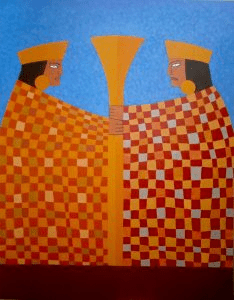
The exchange of the chumpi, the woolen sash, becomes a powerful symbol of unity and mutual commitment.

The Andean wedding ceremony captures this sacred essence of love.

Chumpi, the woolen sash

This ritual, steeped in ancestral significance, binds the couple together in a shared path, signifying their intertwined destinies.

The Enchantment of Love Andean Ceremonies

As we embrace love and its enchanting manifestations, let us remember that it is a force to be cherished, nurtured, and celebrated with reverence and joy.

The Andean worldview, guided by principles of reciprocity and complementarity, underscores the importance of balance and harmony.

The Andean Cross, or Chakana, represents the integration of various realms of existence, linking the upper (Hanaq Pacha) and lower (Ukhu Pacha) planes, as well as the feminine and masculine energies.

This sacred geometry mirrors the relational and complementary principles that govern life, emphasizing the interconnectedness of all things.

Chacana is an Inca symbol

As the couple embarks on this sacred journey, they offer a traditional toast to the sacred mountains. They invoke the blessings as an act of reverence to the Apus to protect and guide their union.

The Andean wedding ceremony becomes a magical celebration where the spiritual and the earthly unite.

It is a vivid reminder that love, in all its splendor, is both a sacred gift and a profound responsibility—a journey of mutual growth, shared dreams, and enduring commitment, blessed by the ancient spirits of the Andes.

In every sacred ritual and heartfelt connection, love shines as the reason for life, guiding us through the timeless dance of union and harmony.

Inti: Father Sun

Posted on

“Father Sun, my Father,” the Inca shouts during the Inti Raymi ceremony, honoring Inti, the Sun God.

The sun’s radiance has fascinated cultures worldwide, illuminating days and symbolizing divinity across epochs.

Father Sun, revered as the source of all wealth and the ruler of the heavens, plants, and the universe, occupies a central place in the Inca pantheon.

As the sun god, Inti was closely linked to agriculture, providing the essential light and warmth for crop growth.

In this blog, we will explore Inti’s significance, his influence on Inca society, and his enduring legacy.

Inti, the sun itself, was their primary deity.

Who Was Inti Father Sun?

Inti was believed to be the son of Wiracocha, the creator deity, and Mama Cocha, the goddess of the sea.

According to Inca legends, Inti had two sisters: Pachamama, goddess of the earth, and Mama Killa, goddess of the moon.

Mama Killa was considered Inti’s wife in some versions of the myth. Father sun’s influence on Inca life was profound, as he controlled agricultural activities crucial for their survival.

While generally benevolent, Inti could show his displeasure through solar eclipses, necessitating sacrifices to restore his favor.

Inti Family Tree

Inti in the Sky: Astronomical Basis and Iconography

The Incas, residing in regions like the Sacred Valley, were keen observers of the sky.

The sun’s movements dictated their calendar and agricultural practices, making Inti a guiding celestial force.

For example, Machu Picchu’s structures align with specific solar patterns, reflecting the Incas’ sophisticated understanding of the sun’s path.

Solar observations influenced Inti’s iconography, which commonly featured a golden disk with a human face.

Golden disk with a human face.

Gold, associated with Father Sun due to its brilliant sheen, symbolized the “sweat of the sun.”

Inti is often depicted alongside the crescent moon, representing balance and harmony between day and night, male and female. This duality underscored the astronomical observations embedded in Inca culture.

This divine lineage allowed them to rule with unquestionable authority. Inti’s celestial presence was felt throughout the empire, from Cusco’s sacred sites to Machu Picchu’s high terraces.

His role illuminated both the physical and spiritual realms of Inca life.

Inti on Earth: Social and Cultural Impact

Inti’s influence extended beyond the celestial sphere into the social and cultural fabric of the Inca Empire.

It played a crucial role in agriculture. As the giver of warmth and light, he controlled crop growth and harvests.

This celebration highlighted the sun’s importance in sustaining the Inca way of life.

The temple’s walls of Qoricancha were once lined with gold, symbolizing the sun’s radiance.

Ritual offerings to Father Sun, including gold and silver figurines, were common, aiming to maintain harmony and receive his blessings.

Gold and Silver

Artistic depictions of Inti, found on pottery, textiles, and architectural designs, further illustrate his cultural significance.

His imagery adorned royal clothing and was a testament to the intertwined nature of religion and daily life in Inca society.

Inti Raymi

The Inti Raymi festival, held annually during the winter solstice, honored Father Sun and marked the start of the agricultural season.

This major Inca event continues today, drawing thousands of locals and tourists and showcasing the enduring veneration of Father Sun.

The festival begins before dawn with a solemn procession in Cusco’s main square to celebrate the rising sun.

Inti Raymi festival

The Inca offers chicha to Father Sun and rekindles sacred fires at the Coricancha, accompanied by dances and sacrifices of grain, flowers, and animals.

Celebrated in June, the festival involves animal sacrifices, including white llamas, and remains a vibrant tradition across the Andean region. Visiting Machu Picchu after the festival is highly recommended for a complete experience.

Modern Celebrations and Alternatives

During Inti Raymi, Cusco’s center is closed to regular traffic, with only tourist vehicles allowed to transport visitors.

If you can’t attend on June 24, you can still experience Inca culture through folk dances and traditional performances in Plaza de Armas during the two weeks leading up to the festival.

Inti Raymi in Plaza de Armas – Cusco

Inca Altar Of The Qoricancha – Part 6

Posted on

Welcome to the sixth section of our exploration of the elements of the Inca altar at Qoricancha! A representation of the Andean cosmovision.

It shows us the hierarchies of the Inca criteria; moreover, it explores the reasons for correspondence and equality, presenting a symbol that is still being studied.

If you haven’t seen Part 1, Part 2, Part 3, Part 4 or Part 5 yet, we remind you to read them first and then come back here.


High Inca Altar of Qoricancha

Inca Mallquis

The Andean people believed that after this life, or Kay Pacha, the souls of the dead lived a new existence, either in Hanan Pacha or heaven, or in Ukhu Pacha or hell.

They also believed that the souls would return to life and that for this, they would need their bodies, which is why they preserved their deceased mummified.

Mummies were not exclusive to the imperial caste.

The people themselves maintained this tradition and custom; each of the Ayllus had its own Mallqui, the corpse of the oldest patriarch, who was always accompanied by the mummy of his wife.

The “mallquis” are the ancestors, the mummies, or their representations.

Others joined these Mallquis; people kept their corpses because of their deeds, whether they were great warriors or very devoted priests.

Common people also underwent a preservation process, were buried on high ledges and difficult-to-access hills, and covered with mud. Today, there are no fewer than 10 cemeteries between Ollantaytambo and Calca, and in the surroundings of Qosqo, there are numerous collective tombs.

People buried many bodies in trees by digging deep into the tree’s roots, placing the deceased there, and then reburying and covering everything.

At other times, people placed the bodies inside the trunk.

Many mummies remained preserved in perpetual snow, while others rested on mountain peaks.

The Andes people deeply rooted their cult of the dead. They had very diligent customs and a profound cult.

The Tree

The following drawing of the cosmogonic retablo is the tree, which represents life emerging from the earth and reaching toward the infinite.

  • Hanan Pacha is the crown of the tree suspended in space, in direct communication with the wind and sunlight; it is the part that connects with the infinite beings.
  • Kay Pacha is the strong, rugged trunk, representing humanity and its labor. It shows that life can twist like the trunk of some trees or stay straight like others, and that life can be either long-lived or short-lived.
  • Ukhu Pacha is the root, connected subterraneously to the deep center of the earth. It symbolizes rooting and gregariousness. It shows that the root is the final support for anything to exist on earth; without it, nothing can survive.
The tree symbolizes the link that connects the three worlds.

The root is nourishing, seeking the sources of the bodies of all ancestors.

Through the root come the fruits of the earth, and the condition of the tree reflects the condition of those who cared for it. The tree represents all of plant nature.

It lives like humans, fulfilling a specific task, not being aggressive; on the contrary, it shelters and is not selfish but extends its branches full of fruit.

Nature offers itself to humans, and humans should reciprocate in the same manner.

Mama Ccocha

Mama Ccocha, the elemental water, represents the principle and rebirth. It symbolizes relativity, the eternal becoming, and teaches that everything is a cycle, coming and going like human life.

People made expensive offerings to the water and valued it in different colors, each with a very special meaning.

The first gesture of hospitality for a traveler is to offer water, and then to give more of it in a gifted pitcher.

Water is the second most important element for the existence of life.

It flows like human life, occupies the Three Worlds, and thus knows and advises.

People consider it a huaca of utmost importance and worship it in all its manifestations:

  • Sea
  • Lake
  • Lagoon
  • River
  • Spring
  • Rain
  • Beverage
  • Irrigation
  • Absence
  • Deluge

For the Incas, the importance of things lies in the teachings they offer. The Incas believed in the existence of water spirits and associated them closely with the Moon.

Water cures many diseases, and Andean priests and doctors heal ailments with water from springs that have not received sunlight.


Reference