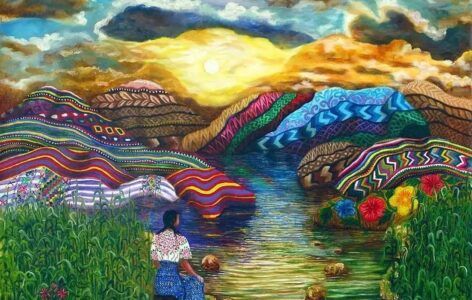
In the previous blog, we explored Moray as a sacred laboratory, a living temple. Pachamama and human intention was to met through the spiral of reciprocity.
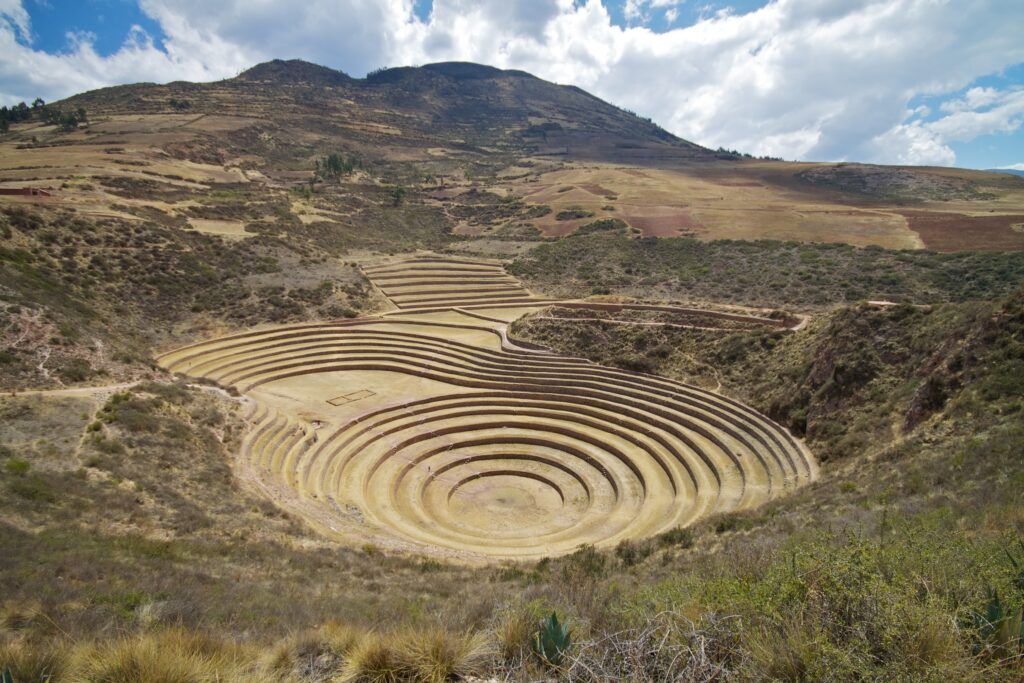
Today, we move deeper into its cosmic dimension, where Moray emerges not only as an agricultural center but as a calendar of time. It is a mirror of the heavens etched into the Earth.
Aligning with the Sun: Moray as a Temple of Time
The Incas understood time not as linear but as cyclical, unfolding through pacha—a word meaning both “space” and “time.”
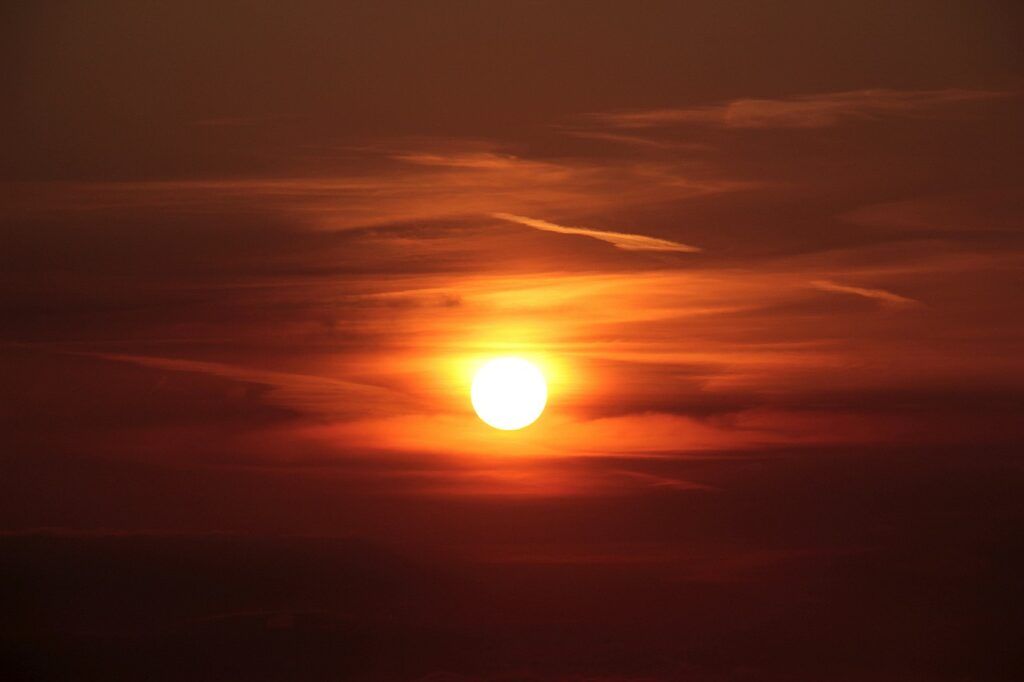
In this worldview, human ceremony and agricultural rhythm reflected the movement of the sun, the moon, and the stars.
Moray, with its descending circles and solar alignments, served as an observatory where light, temperature, and shadow marked the turning of the year (Zuidema, 1982; Bauer & Dearborn, 1995).
At solstices, the terraces likely became instruments of ritual observation: when the first light of Inti (the Sun) touched specific levels, it signaled the beginning of planting or harvesting. Each descent into Moray’s circles mirrored a journey into Uku Pacha, while each ascent symbolized return to Hanaq Pacha.
The Geometry of the Cosmos
Moray’s circular terraces are not arbitrary—they express the Andean understanding of cosmic order. In this geometry, the circle represents continuity, inclusiveness, and the eternal breath of Kawsay.
Urton (1981) describes how the Andean cosmos is structured in triads, Hanaq, Kay, and Uku Pacha, each interconnected through the movement of ritual and time.
Through ceremonies attuned to the sun and moon, the Incas renewed the bonds of ayni between the human world and the cosmic forces.
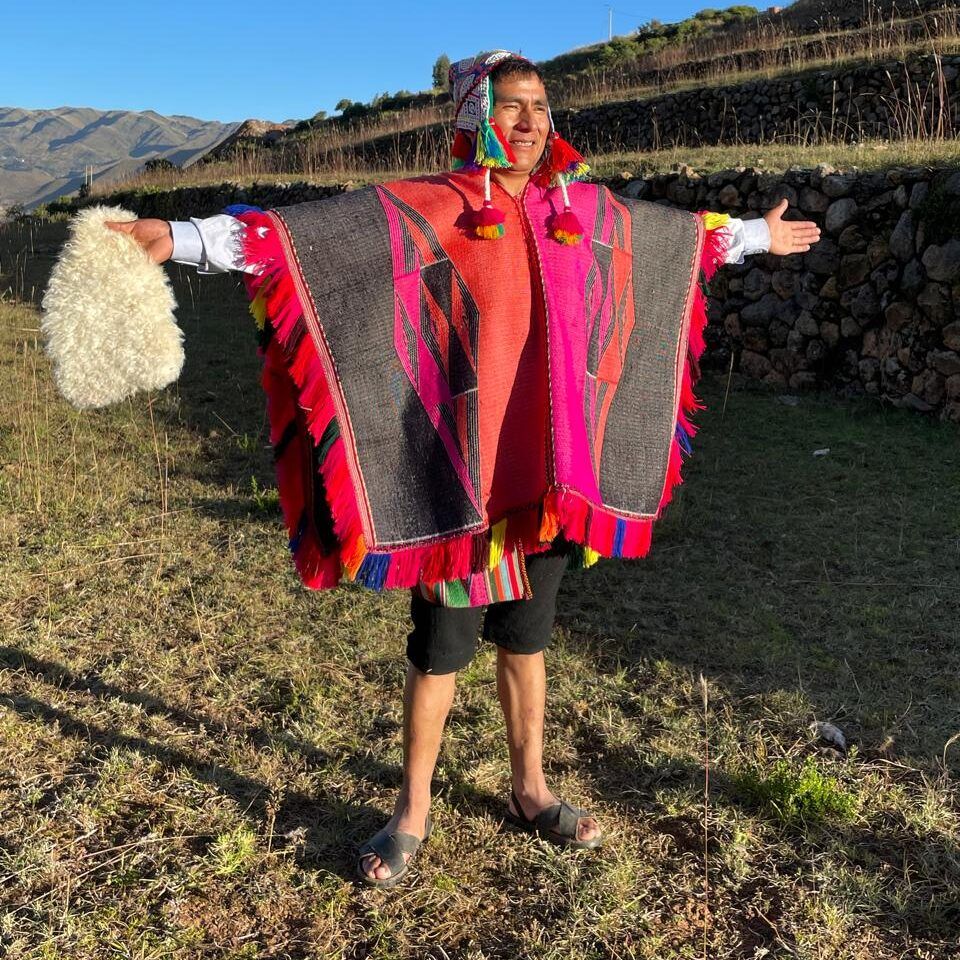
Offerings of chicha, coca, and sacred herbs like wilka and San Pedro transformed the terraces’ center into a cosmic altar where Earth and Sky conversed.
Ritual Calendars and Agricultural Consciousness in Moray
Moray was part of a broader ritual calendar that united cosmic and ecological cycles.
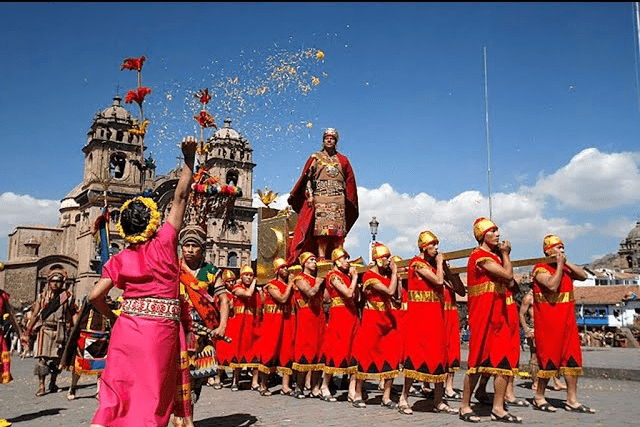
The Incas celebrated Inti Raymi (Festival of the Sun), Coya Raymi (Festival of the Moon), and Kapak Raymi (Festival of Renewal), aligning agricultural tasks with celestial movements. This integration reveals that for the Inca, agriculture was not merely sustenance, it was a ceremonial act of cosmic participation (Aveni, 2008).
The terraces thus operated as both ecological and ritual tools, measuring the fertility of soils and synchronizing the heartbeats of humans with those of the cosmos. The patterns of light and shadow, heat and cold, mirrored the dual rhythms of yanantin and masintin, balance and complementarity, through which the Andean world found harmony.
Moray ‘s Sacred Spiral of Time
Walking down into Moray, one moves through more than architecture; one enters a spiral of consciousness. Each step downward marks a descent into the womb of Pachamama, and each return upward signifies rebirth. In this sense, Moray becomes not only an observatory of the sky but a ritual of remembrance, an embodied meditation on how life and time continuously return to their source.
References
- Aveni, A. (2008). Foundations of New World Cultural Astronomy: A Reader with Commentary. University Press of Colorado.
- Bauer, B. S., & Dearborn, D. S. P. (1995). Astronomy and Empire in the Ancient Andes: The Cultural Origins of Inca Sky Watching. University of Texas Press.
- Urton, G. (1981). At the Crossroads of the Earth and the Sky: An Andean Cosmology. University of Texas Press.
- Zuidema, R. T. (1982). Inca Observations of the Solar and Lunar Passages. In Archaeoastronomy in the New World. Cambridge University Press.