
In the Andean calendar, January carries patience: plant without proof. During the height of the rainy season, farmers place seeds into saturated soil, fully aware that weeks will pass before any visible sign appears.

This act requires discipline, humility, and trust in Pachamama.
Rather than offering confirmation or clarity, this month demands relationship with uncertainty. It teaches patience not as waiting, but as active trust in processes unfolding beyond perception.
Agricultural Wisdom as Spiritual Teaching
In Andean communities throughout the highlands of Cusco and the Sacred Valley, sowing during the rains follows precise ancestral timing.
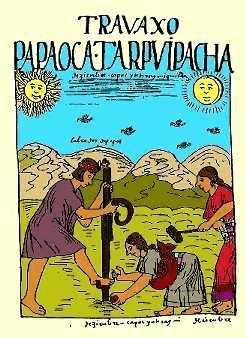
Farmers do not plant to control outcomes; they plant to enter dialogue with land, weather, and unseen forces.
Seeds disappear beneath the soil. Doubt follows naturally.
Yet Andean wisdom holds that questioning the process too early interrupts ayni, the sacred reciprocity between human effort and natural intelligence.
To sow without seeing is to honor timing over urgency.
The Unseen Work of Uku Pacha
Once seeds enter the earth, their transformation begins in Uku Pacha, the inner and ancestral realm.

This phase involves:
- Disintegration of the seed’s original form
- Reorganization of energy and matter
- Root formation before emergence
Nothing about this process looks productive from the surface.
Similarly, spiritual and psychological transformations often begin with confusion, fatigue, or loss of direction. From an Andean perspective, these states signal that deep rooting is underway.
Uku Pacha works in darkness by necessity.
Why Doubt Appears During January
Many people experience January as a month of doubt:
- “Why does nothing feel clear?”
- “Why haven’t I changed yet?”
- “Why does progress feel invisible?”
Andean tradition does not interpret these questions as failure. Instead, it recognizes them as threshold experiences moments when the old self dissolves before the new one stabilizes.
Western Urgency vs. Andean Timing

Doubt surfaces because the ego cannot witness subterranean change.
Patience, in this context, becomes a form of spiritual strength.
Western frameworks often equate growth with visibility. Productivity, success, and healing must appear measurable. Andean cosmology challenges this assumption by honoring invisible labor.
Forcing clarity too soon creates hucha, heavy energy that disrupts natural unfolding. Trusting the unseen, however, preserves vitality and coherence.
The Earth never reveals growth on demand.
Patience as Sacred Discipline
In the Andes, patience does not mean passivity. It requires:
- Consistent care without control
- Attention without interference
- Faith without reassurance
This discipline cultivates resilience, grounding, and long-term stability. What grows slowly tends to endure.
Seeds that rush toward light often weaken at the root.
Applying Patience to Modern Life

To live this teaching today means allowing periods of uncertainty without self-judgment. It means resisting the urge to explain, label, or finalize experiences prematurely.
January reminds us that clarity often arrives after rooting, not before.
Those who trust the process even when nothing appears to be happening align themselves with a wisdom far older than strategy.
References
- Allen, C. J. (2002). The hold life has: Coca and cultural identity in an Andean community. Smithsonian Institution Press.
- Bastien, J. W. (1985). Mountain of the condor: Metaphor and ritual in an Andean ayllu. Waveland Press.
- Isbell, B. J. (1978). To defend ourselves: Ecology and ritual in an Andean village. University of Texas Press.
- Urton, G. (1981). At the crossroads of the earth and the sky: An Andean cosmology. University of Texas Press.