
As late August approaches, the intense solar heat accelerates soil preparation across the high Andean agricultural terraces. The earth lies open, turned, and sowed with seeds (Wilka), but the topsoil remains bone-dry. Within Andean cultural traditions, this delicate agricultural transition is marked by Tarka Wayra. This is the ceremonial playing of carved wooden flutes to invoke the coming rains.

When the dry, late-August winds whistle across the mountain ridges, musicians gather at the edges of the newly planted fields. They lift their instruments to the sky, transforming human breath (Phukuy) into a resonant sonic prayer that invites the rain clouds to gather.
The Sonic Geometry of the Tarka
Unlike soft-sounding reed flutes, the Tarka is rectangular, carved out of dense, sacred hardwoods such as mahogany or orange tree wood. Its unique mouthpiece produces a rich, buzzy tone (Tara) filled with complex acoustic harmonics that travel great distances across high-altitude valleys.
This acoustic power mirrors the fundamental practice of Nawpa Tinkuy, the art of harmonious vibration.
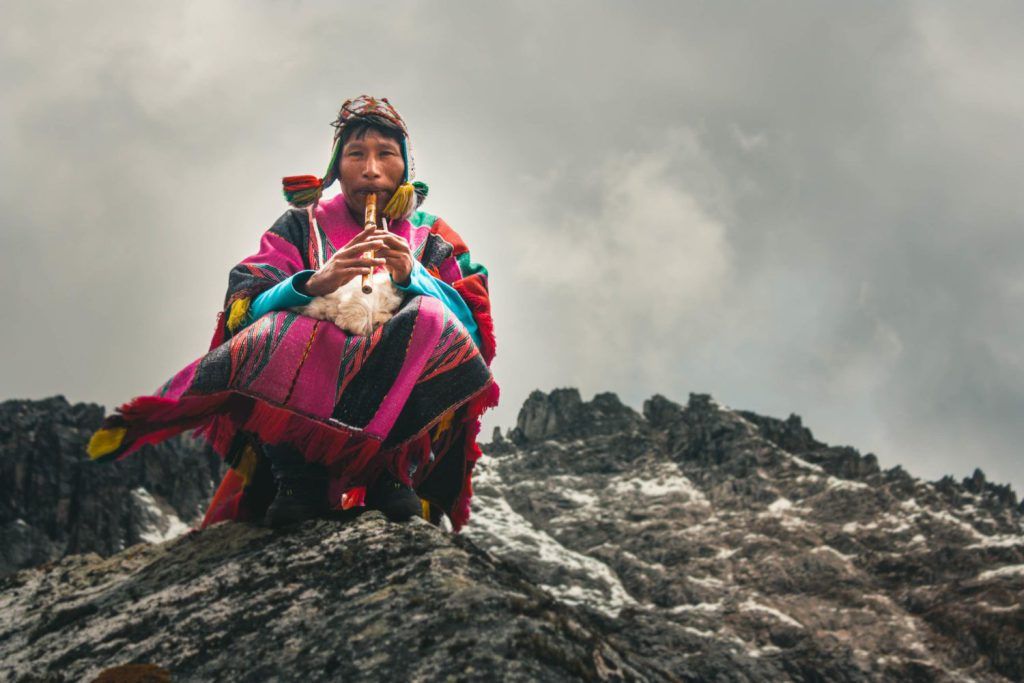
In Andean cultural traditions, sound is not passive entertainment; it is an active physical tool that restructures atmospheric energy (Kawsay). The sharp, rattling frequency of the Tarka mimics the sound of distant thunder and falling water droplets. When played in coordinated groups, the collective resonance vibrates through the parched soil and the atmosphere, signaling to the cloud spirits (Pukyu Mama) that the seed is in the ground and the earth is ready for life-giving rain.
The Breath of Intention
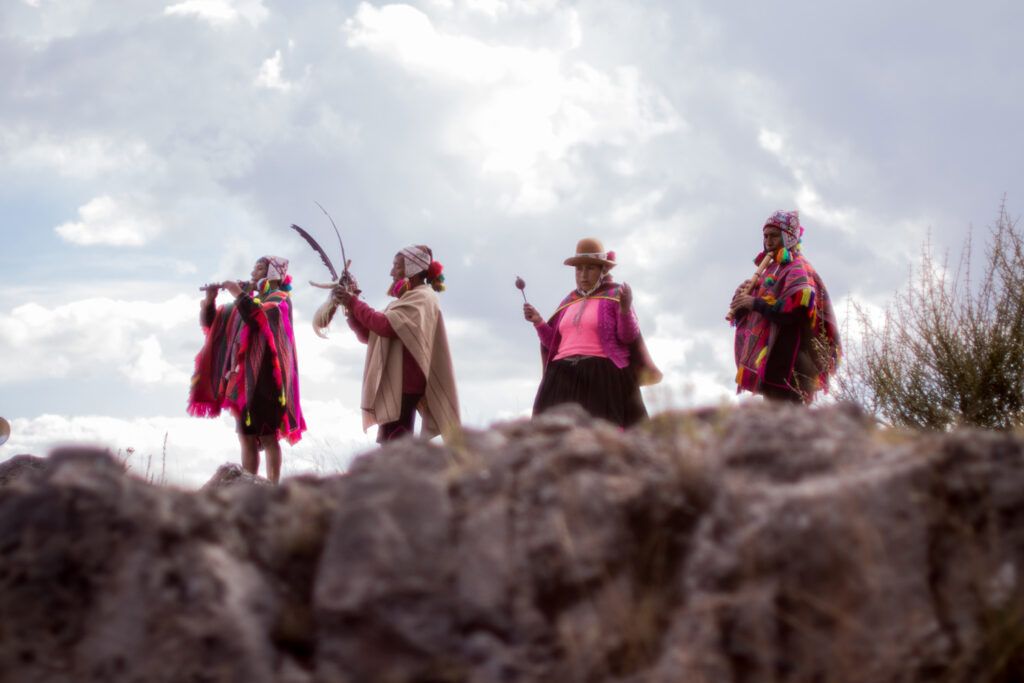
Playing the Tarka relies on Phukuy, the intentional transmission of life force through sacred breath. As the musician blows into the wood, they do not simply move air. They project their prayers for fertility, growth, and communal abundance through the instrument.
By uniting human breath with carved wood and mountain wind, the music acts as an acoustic bridge between the human community (Runakuna) and the celestial realms. You do not force nature to yield. You sing to her in a language she recognizes, inviting the rains to fall in gentle, restorative balance rather than destructive storms.
“When the earth is dry, do not shout at the sky. Sing through the wood until the clouds recognize their own voice in your song.”
The Language of Sound
- Tarka: A traditional, rectangular wooden flute carved from hardwood, played in groups to welcome spring and invoke rain.
- Tara: The rich, buzzing harmonic timbre produced by the Tarka, specifically tuned to resonate with atmospheric energy.
- Phukuy: The sacred act of blowing breath loaded with intention onto coca leaves, ceremonial objects, or musical instruments.
The Valleys of Sacred Resonance
- The Valley of Lucre (Huacarpay Wetlands): Located southeast of Cusco. This rich wetland basin acts as a natural amplifier for acoustic traditions, where local musicians historically gather along water margins to play wind instruments during early spring preparations.
- The High Terraces of Ollantaytambo: Surrounding the ancient Incan living fortress. These steep, rock-walled valley corridors channel mountain winds, allows the resonant tones of wooden flutes to echo across the terraced fields.
References
- Turino, T. (1993). Moving Away from Silence: Music of the Peruvian Altiplano and the Experience of Urban Migration.
- Stobart, H. (2006). Music and the Poetics of Production in the Bolivian Andes. Ashgate Publishing.
This article draws on both academic literature and oral, lineage-based Andean knowledge. Teachings that originate from living traditions are cited in recognition of their ongoing transmission within Andean communities, while scholarly sources are used to support contextual interpretation.