logo im

No Cultural Appropriation in Andean Wisdom Part 2

Posted on

In our previous blog, we shared our perspective on why the concept of cultural appropriation. It does not apply within the Andean world, using the example of the Q’ero paqos.

In Cusco Peru In the Andes

In this new post, we seek to deepen that reflection by presenting four reasons why “cultural appropriation”. It is not only incompatible with Andean reality but also a limited and problematic way of understanding it.

Why “cultural appropriation” is a problematic lens

1. The assumption of separability

Most people who use the term “cultural appropriation” assume they can meaningfully separate a set of symbols or rituals from their original context and re-use them in another.

But in Q’ero cosmology, the sacred is not a set of static artifacts; it is living ayan (energetic existence). To extract a ritual without the sustaining infrastructure (lineage, relationship, reciprocal balance) is to distort it.

2. The question of authority and consent

Appropriation critiques often hinge on the lack of consent from the originating community.

But in the case of paqos, the authority to teach, initiate, or transmit is not a generic license; it is grounded in lineage, khipu (connections), and spiritual responsibility.

Even within Q’ero themselves, not everyone becomes a paqo: there are levels and qualifications (e.g. altumisayuq vs pampamisayuq).

Thus, an outsider may not simply step in and claim “permission”—the possibility of genuine transmission depends on being incorporated into a relational structure, not on a transactional “permission slip.”

3. Risk of dilution and commodification

One valid critique is how New Age tourism and spiritual commodification can dilute or exoticize Q’ero practices for consumption.

Melody J. Devries, in “Heritage Appropriation and Commoditized Spirituality,” argues that spiritual tourism can turn Q’ero mysticism into a spectacle, stripping the deep relational matrix around it.

But this does not claim that “appropriation is possible” in a pure sense—rather, it warns that people can sensationalize, misinterpret, or alienate fragments from their sovereignty.

4. The limits of Western concept of Cultural Appropriation

The very concept of “cultural appropriation” is born from Western debates around power, identity, and property. Applying that framework rigidly to Andean spiritual systems can mis-map how indigenous epistemologies understand knowledge, authority, and relationality.

In other words: we risk reducing a living ontology into a debate about cultural objects.


A reframed view: integrity, relationship, responsibility

Rather than “appropriation,” a more fertile paradigm is to consider integrity, relationship, and responsibility. Here’s how:

  • Integrity: The ritual must be preserved in its energetic coherence, not treated as a “tool.”
  • Relationship: Transmission requires connection, lineage, and reciprocity (not just license).
  • Responsibility: One must uphold the ethical duties, not only perform the ritual superficially.

From this view, the question is not “Can one appropriate Q’ero rituals?” but: Can one earn the right to responsibly walk with them, without distortion, and in relation? If not, one should not claim them.


Bibliography

  • Devries, Melody J. “Heritage Appropriation and Commoditized Spirituality: Q’ero Mysticism & Andean New Age Healing.” NEXUS 23, no. 1 (2015).
  • “What is Q’ero Spiritual Tradition Today?” MemoryQero.
  • “Coca Leaf Reading and Healing Discussion from Hatun Q’ero Paqos of Peru.” ShamanicPractice.org.
  • “Paqos on a Pedestal.” Q’enti Wasi

Sacred Agriculture of the Incas Part 2

Posted on

In the previous blog, we explored how Inca agriculture was a sacred dialogue with Pachamama and the living energy of Kawsay. Today, we turn our gaze to the sky — to the cosmic cycles and ritual calendars that guided every seed, harvest, and ceremony. For the Andean peoples, time was not linear but Pacha — a living fabric woven by the movements of Inti, Killa, and the stars. To follow these celestial rhythms was to live in harmony with the pulse of the universe itself.

Ritual Calendars and Cosmic Cycles for Agriculture

The Inca calendar was both astronomical and spiritual—a woven system of time that linked agricultural work to the rhythm of the stars. The Incas aligned sowing, harvesting, and ritual ceremonies with the solar and lunar cycles. They observed the movement of constellations such as the Chakana (Southern Cross) and Pleiades, known as Qollqa, the celestial storehouse.

Nine stars of Pleiades- Qoricancha

Each agricultural phase mirrored a cosmic event. The Inti Raymi marked the rebirth of the solar cycle, a time to thank Inti for the returning light. The Coya Raymi (September equinox) honored the feminine aspect of the cosmos and initiated planting season with rituals to Pachamama. During Capac Raymi (December solstice), communities offered gratitude for the ripening crops, celebrating balance between light and shadow.

Through this calendar, agriculture became an act of cosmic synchronization. Every ritual ensured that human action resonated with the heartbeat of the universe—Pachakuti, the sacred cycle of renewal and transformation. To cultivate was not only to feed the body but to maintain harmony between Kay Pacha, Hanan Pacha, and Uku Pacha.


Agriculture: Seeds of Reciprocity and Biodiversity

In the Andean valleys, agriculture was also an act of communal ayni. Farmers exchanged seeds across ecological zones—from the highlands to the jungle—expanding biodiversity and resilience in times of drought or frost (Vegetation History and Archaeobotany, 2023). These exchanges were not economic but ceremonial, reinforcing ties of kinship between human communities and the landscape itself.

Labor was shared, and in return, community support was provided for essential needs.

According to Kosiba (2018), the Inca state institutionalized these principles at an imperial level, creating vast agricultural networks that maintained balance between productivity and sacred reciprocity. Fields were divided between the Sun, the state, and the people—reflecting a cosmological order where no act of cultivation was separate from the divine.


The Temple of the Living Earth

Each chakra (field) was considered a microcosm of the universe, tended with ritual offerings of coca, chicha, and song.

Before planting, farmers performed pachamamaq challay, the ceremonial feeding of the earth, to ensure that the seeds would awaken in harmony. These gestures were not superstition—they were a recognition that life depends on relationship, not domination.

Modern ecological science now echoes what the Incas knew intuitively: the health of an ecosystem depends on reciprocity, diversity, and respect for cycles.

In this sense, Inca agriculture offers not only a historical model but a spiritual ecology—a way of remembering that the Earth is alive and that all cultivation is communion.


References

  • Bray, T. L. (2017). Water, Ritual, and Power in the Inca Empire.Latin American Antiquity. Cambridge University Press.
  • Frogley, M. R., Chepstow-Lusty, A., Thiele, G., & Aucca Chutas, C. (2025). Trees, terraces and llamas: Resilient watershed management and sustainable agriculture the Inca way. Ambio, 54(5), 793–807. https://doi.org/10.1007/s13280-024-02121-5
  • Kosiba, S. (2018). Cultivating Empire: Inca intensive agricultural strategies. In S. Alconini & A. Covey (Eds.), The Oxford Handbook of the Incas (pp. 227–246). Oxford University Press.
  • MDPI Archaeologies. (2023). Spatial, Functional, and Constructive Analysis of the Water Resource at the Archaeological Center of Tipón, Cusco, Peru.https://www.mdpi.com/2571-9408/7/12/307
  • Vegetation History and Archaeobotany. (2023). Pre-Hispanic terrace agricultural practices and long-distance transfer of plant taxa in the southern-central Peruvian Andes. Vegetation History and Archaeobotany, 33, 375–391.

Sacred Agriculture of the Incas Part 1

Posted on

In the Andean world, agriculture was never merely about production—it was a sacred dialogue with Pachamama (Mother Earth) and the living energy known as Kawsay.

Every seed, every drop of water, and every terrace carved into the mountain reflected the principle of ayni, or sacred reciprocity: a living exchange between humans, nature, and the Apus.

The Inca civilization developed one of the most sophisticated agricultural systems in the world. Yet its genius was not only technical—it was spiritual.

The Incas saw the Earth as a being who breathes, feels, and responds. To plant a seed was to enter a covenant, an act of service rooted in Munay, Llankay, and Yachay.


Living in Harmony with the Land and Agriculture

Recent studies confirm that the Incas integrated sustainable ecological principles that remain relevant today.

They constructed terraces, practiced agroforestry, and managed mountain watersheds with precision, avoiding deforestation and erosion while maintaining soil fertility through the use of llama manure (Frogley et al., 2025).

Such systems demonstrate that Inca agriculture was as much about spiritual alignment as environmental balance.

At the heart of this relationship was water.

The sacred site of Tipón, near Cusco, reveals a stunning example of hydraulic engineering intertwined with ritual practice. Spring waters flowed through channels and fountains where offerings were made, symbolizing the continuous nourishment between humans and the divine (Bray, 2017; MDPI Archaeologies, 2023).

In Andean thought, Yaku Mama (Mother Water) was both a practical and spiritual force—the mirror of life itself.


Sacred Techniques of Inca Agriculture

What we call “farming techniques” were, for the Incas, ritual technologies of energy exchange. Each act of cultivation was imbued with intention, offering, and reciprocity.

Some of the most revered techniques include:

  • Wachu – the raised field system that allowed the land to breathe, creating warmth and protecting crops from frost. These fields mirrored the lungs of Pachamama, circulating life energy through the soil.
  • T’oqo – ritual holes dug before sowing, symbolizing the womb of the Earth where Kawsay gestates. Offerings of coca, chicha, and llama fat were placed inside to awaken the spirit of fertility.
  • Chakra Pampa – the communal field, where families gathered to sow and harvest together under the principle of ayni. Labor was ceremony; songs, dances, and prayers harmonized collective intention.
  • Coca K’intu – three sacred coca leaves offered to the Apus and Pachamama before planting, aligning human effort with the consciousness of the mountain and the sky.
  • Pachamamaq Challay – the “feeding of Mother Earth,” performed before each planting season to honor the soil and ask permission to awaken her abundance.

These techniques were not simply efficient—they were energetic and ethical. The Inca farmer was a ritual technician, one who cultivated both matter and spirit. The act of farming became a form of prayer, uniting cosmos and soil through human hands.


References

  • Bray, T. L. (2017). Water, Ritual, and Power in the Inca Empire. Latin American Antiquity. Cambridge University Press.
  • Frogley, M. R., Chepstow-Lusty, A., Thiele, G., & Aucca Chutas, C. (2025). Trees, terraces and llamas: Resilient watershed management and sustainable agriculture the Inca way. Ambio, 54(5), 793–807. https://doi.org/10.1007/s13280-024-02121-5
  • Kosiba, S. (2018). Cultivating Empire: Inca intensive agricultural strategies. In S. Alconini & A. Covey (Eds.), The Oxford Handbook of the Incas (pp. 227–246). Oxford University Press.
  • MDPI Archaeologies. (2023). Spatial, Functional, and Constructive Analysis of the Water Resource at the Archaeological Center of Tipón, Cusco, Peru. https://www.mdpi.com/2571-9408/7/12/307
  • Vegetation History and Archaeobotany. (2023). Pre-Hispanic terrace agricultural practices and long-distance transfer of plant taxa in the southern-central Peruvian Andes. Vegetation History and Archaeobotany, 33, 375–391.

No Cultural Appropriation in Andean Wisdom Part 1

Posted on

In contemporary discourse about intercultural exchange, “cultural appropriation” is often invoked when symbols, rituals, or spiritual practices of a marginalized culture are adopted superficially or commercially by outsiders.

Yet this concept can misfire if applied indiscriminately—especially when we speak of the paqos of the Q’ero tradition.

The spiritual path of the paqo is not a decorative asset or a borrowed aesthetic. It is alive, rooted, and inseparable from a cosmovision rooted in Kawsay.

From that vantage, we argue that to frame outsider use of Q’ero practices in terms of “appropriation” is both misleading and limits our capacity to understand their depth.


Who are the Q’ero and the paqos?

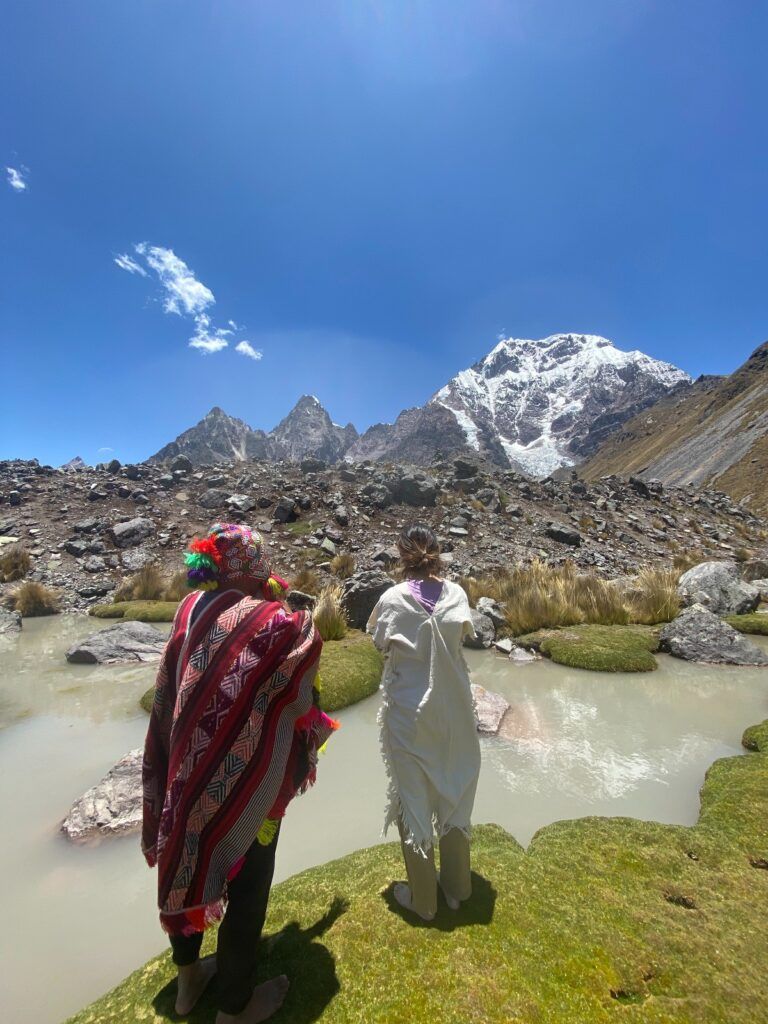
The Q’ero Nation, who guard one of the highest regions in the Peruvian Andes near Apu Ausangate and Paucartambo, carry the living lineage of the Inka. Within their sacred community, the paqos are not merely practitioners, but mediators between the seen and unseen worlds.

They work through the living energies of Munay, Yachay, and Llankay, serving as bridges between humanity and the sacred landscape of Pachamama and the Apus.

In the Q’ero tradition taught within Inca Medicine School, ritual, cosmology, and ethics are inseparable threads of the same Kawsay.

Principles such as Ayni, Hucha Mikhuy, and Coca Divination operate as living expressions of an ancient energetic system (not as isolated techniques to be borrowed or imitated). But as forces that breathe through relationship, intention, and respect.

For this reason, the path of the paqo cannot be reduced to a “cultural object” or spiritual trend. It embodies a living kamay—a sacred way of being—rooted in its lineage, ethics, and cosmic foundations.

Some cautions & limitations of cultural appropriation

  • Not every outsider who learns is acting in bad faith; some genuinely seek resonance and respect.
  • The boundaries of who is “inside” or “outside” are fluid; intercultural relationships can be complex.
  • Indigenous communities are not monolithic; some Q’ero may teach or share under certain conditions.
  • We must remain humble, recognizing that we cannot fully speak “for” the Q’ero as a whole.

To say that “cultural appropriation does not exist for the paqos Q’eros” is not to deny that harm or misuse can occur.

Rather, it emphasizes that the very assumption behind appropriation—that people can detach, decontextualize, and reuse practices—does not apply cleanly to a living, relational tradition.

With respect, care, and inclusion, perhaps paths of co-walking rather than taking are possible.

In the work of IncaMedicineSchool, our aim is not to “adopt” Q’ero practices as exotic modules, but to honor them, to enter into ayni with them, to support authentic transmission while resisting superficial appropriation.


Bibliography

  • Devries, Melody J. “Heritage Appropriation and Commoditized Spirituality: Q’ero Mysticism & Andean New Age Healing.” NEXUS 23, no. 1 (2015).
  • “What is Q’ero Spiritual Tradition Today?” MemoryQero.
  • “Coca Leaf Reading and Healing Discussion from Hatun Q’ero Paqos of Peru.” ShamanicPractice.org.
  • “Paqos on a Pedestal.” Q’enti Wasi

Silence in Andean Rituals: Listening to the Living Cosmos

Posted on

In many spiritual traditions, sound is central to prayer and ceremony. But in the Andean world, silence carries an equally profound sacred weight. For the peoples of the Andes, silence is not emptiness—it is presence. It is the moment when one becomes aware of Pachamama (Mother Earth), the Apus (mountain spirits), and the subtle flow of kawsay (living energy).

Silence ‘s Function

Anthropologist Catherine Allen notes that in Andean ceremonies, silence often prepares the way for offerings: “The pause is not absence, but a form of listening to the earth and sky” (The Hold Life Has, 1988).

Before coca leaves are placed on the ground, before words are spoken to the spirits, practitioners may fall into a collective quiet. This silence is understood as an act of respect, a suspension of the self so that the sacred may speak.

Silence also functions as a bridge to ayni (reciprocity).

By quieting one’s own voice, space opens to hear the voice of water, wind, or fire. In some rituals, the absence of speech allows the paqos (Andean priests) to sense shifts in energy, to notice how hucha (heavy energy) is leaving or how light is descending.

Thus, silence becomes a diagnostic tool and a healing act.

Unlike Western notions of silence as void or absence, the Andean sense is relational. It is the stillness of dawn before the sun (Inti) rises, the hush of mountains holding their breath, the pause before a drumbeat begins. It is silence filled with life.

“To remain silent in ritual is to enter into dialogue with the unseen. The earth speaks most clearly when we do not.”


Reference

  • Allen, Catherine. The Hold Life Has: Coca and Cultural Identity in an Andean Community. Smithsonian Institution Press, 1988.
  • Bastien, Joseph. Mountain of the Condor: Metaphor and Ritual in an Andean Ayllu. Waveland Press, 1985.
  • Van den Berg, Hans. La Tierra No Da Así No Más: Los ritos agrícolas en la religión de los campesinos del sur andino. IEP, 1990.
  • Mannheim, Bruce. The Language of the Inka Since the European Invasion. University of Texas Press, 1991.

The Myth of Inkarri: The Inca King Who Will Return

Posted on

Few Andean myths carry as much prophetic power as the story of Inkarri. More than a legend, it is a living narrative that preserves hope, memory, and resistance among Indigenous communities of the Andes. The name derives from “Inca Rey” (Inca King), and its central message is one of return, renewal, and justice.

According to oral tradition, when the Spanish conquistadors captured and executed the last Inca rulers, the head of Inkarri was buried in Cusco—the navel of the world. Yet the myth insists that Inkarri did not die.

His body, though dismembered, continues to regenerate underground. One day, he will rise again, restoring harmony to the world and bringing an age of justice for the Andean people.

The anthropologist Catherine Allen describes the myth as “a narrative of pachakuti—a world reversal—where the colonial order collapses and balance is restored through the Inca’s return” (Allen, The Hold Life Has, 1988). In this sense, Inkarri is not only a figure of the past but a symbol of cyclical time and transformation.

A Living Myth of Resistance

Variations of the myth exist throughout the Andes. In some versions, Inkarri’s head is said to be growing beneath Saqsayhuamán, the great fortress above Cusco. In others, it lies beneath the soil of Vilcabamba, the last Inca stronghold. Wherever the body rests, the message remains the same: the king’s return will mark the rebirth of Tawantinsuyu, the Inca’s fourfold empire, and the dawn of a new age.

Saqsaywaman

This myth also expresses the resilience of Andean spirituality. Though colonial powers tried to suppress Indigenous beliefs, the story of Inkarri became a vessel for remembering cultural identity and envisioning liberation. It is both memory and prophecy, teaching that endings are never final but part of the eternal Andean cycle of death and rebirth.

“Inkarrí is not simply a king of the past—he is the seed of a future yet to bloom beneath the earth.”


References

  • Allen, Catherine. The Hold Life Has: Coca and Cultural Identity in an Andean Community. Smithsonian Institution Press, 1988.
  • Flores Galindo, Alberto. Buscando un Inca: Identidad y utopía en los Andes. Instituto de Apoyo Agrario, 1986.
  • Rostworowski, María. History of the Inca Realm. Cambridge University Press, 1999.
  • Urton, Gary. At the Crossroads of the Earth and the Sky: An Andean Cosmology. University of Texas Press, 1981.